How to win more quotes without dropping your price
Jobs are often lost on speed, clarity and trust before price decides. Track your win rate, reply fast, offer two or three options and make saying yes easy.
- A simple way to measure your quote win rate
- Two or three options in place of one fixed figure
- Which jobs are worth quoting, and which to skip
By WhizQuote Editorial · 7 minute read
To win more quotes, reply to inquiries quickly, see the job or get photos, send a clear itemized quote within a day or two, offer two or three options instead of a single price, make accepting simple, and follow up before the quote expires. Measure your quote win rate each month so you can tell which changes actually work.
Start by measuring your quote win rate
Your quote win rate is the share of quotes you send that customers accept: quotes accepted divided by quotes sent, times 100. Measure it by count and by value, because winning lots of small jobs while losing every large one looks healthy on count alone and hides a real problem.
| Month | Quotes sent | Accepted | Win rate by count | Value quoted | Value won | Win rate by value |
|---|---|---|---|---|---|---|
| September | 40 | 14 | 35.0% | $86,000 | $31,500 | 36.6% |
| October | 36 | 15 | 41.7% | $79,200 | $22,800 | 28.8% |
These are example numbers for one imaginary business, not a benchmark. Read together, they tell a story: in October more quotes were accepted, yet the value won fell, which points to the larger jobs being lost. That is the moment to look at how big quotes are priced, presented and followed up. Compare yourself with your own past months, not with figures from other trades.
Reply fast and quote while the job is fresh
The first business to respond properly often sets the standard the others are judged against. Answer inquiries the same day, even if only to book a visit, and send the quote within a day or two of seeing the job. Speed tells the customer how you are likely to run the work itself.
- Reply to every inquiry within hours, with a time for a visit or a request for photos and measurements.
- Price common jobs from a saved list of lines and rates, so a quote takes minutes rather than an evening.
- If a supplier price is holding you up, tell the customer when the quote will arrive, then keep that promise.
- Write the quote straight after the visit if you can, while the details are clearest.
- Put a follow up in your calendar at the moment you send.
Make the quote easy to understand and compare
Customers often compare three quotes that describe the work three different ways. The one they understand fastest has an edge, because uncertainty feels like risk. Break the price into clear lines, describe the scope in plain words and say what is not included, so yours becomes the quote the others are measured against.
- A scope of two or three sentences that a stranger could follow.
- Line items with quantities, units and rates, grouped as materials, labor and other costs. The guide to the itemized quote shows the layout with a priced example.
- Named products and finishes rather than “standard” or “to suit”.
- Exclusions stated openly, so a cheaper quote that leaves things out is easy to spot.
- One clear total with tax shown, and the deposit and balance spelled out.
Offer options instead of one take it or leave it price
A single price invites a yes or a no, and no is easy to say. Two or three options let the customer choose how much to spend with you, and an optional extra or two lets them add value on their own terms. Options also show you thought about their situation instead of pricing a standard job.
| Option | What is included | Price |
|---|---|---|
| Essential | Regrout the tiles, replace all silicone, fit a new exhaust fan | $1,450 |
| Standard (recommended) | Essential, plus a new vanity, faucet and mirror | $3,280 |
| Full refresh | Standard, plus a new toilet, light fixture and ceiling paint | $4,960 |
| Optional extra | Heated towel rail, supplied and fitted | $390 |
| Optional extra | Replace the shower screen | $780 |
Prices are examples for a bathroom refresh. Make the middle option the one you would genuinely recommend, and keep the differences between options easy to see. In the free quote maker, optional items appear on the quote marked Optional and stay out of the total until the customer chooses them.
Show why you, not just how much
When prices are close, customers choose the business they trust to turn up, do the work properly and deal fairly with problems. You can show that on the quote and around it, using facts about your business rather than claims. Keep every statement specific and true, and leave out anything you cannot back up.
- Your license or registration number where your trade requires one.
- A realistic start date and how long the work will take.
- What happens if you find something unexpected, in one sentence.
- The workmanship warranty you actually offer, in plain terms.
- Photos of similar jobs you have finished, when the work is visual or the customer asks.
- A named contact and a phone number that gets answered.
Make saying yes as easy as possible
A customer who has decided should be able to accept in under a minute. Tell them exactly how: reply to the email, sign and return, or call. State the deposit and how to pay it, and the valid until date so they know the price will not hold forever. Every extra step is a chance for the decision to stall.
Put an acceptance line with signature, name and date on the quote itself, and a one sentence next step in your email. Customers often open quotes on their phone, so check that yours reads well on a small screen, with the total and the way to accept easy to find.
Follow up, then learn from every loss
Following up wins jobs that were drifting, and asking about the ones you lose shows you what to fix. Send a short check a few days after quoting and a reminder before the quote expires. When a customer says no, thank them and ask one question about why.
Record each loss with its reason in a simple log, then review it monthly. Patterns show up quickly: if price keeps coming up on one type of job, check your rates for that work; if timing does, look at your lead times. The guide to following up on a quote has the emails, and the guide on replying to a rejected quote covers the no.
Win more jobs by choosing which ones to quote
Your win rate also depends on what you agree to quote. An evening spent pricing a job you were never going to get lowers the rate and takes time from customers who are ready. A few questions at the first contact separate serious inquiries from price checks.
- Is the work in your trade, your area and your capacity for the dates they want?
- Do they have a rough budget, and is it realistic for what they describe?
- Who makes the decision, and will they be at the visit?
- When do they want the work done, and what is driving that date?
- Are they getting other quotes, and how many?
For an inquiry that fails most of these, a quick price range by email may serve both of you better than a full site visit. More on pricing and presentation is in our guides to quoting.
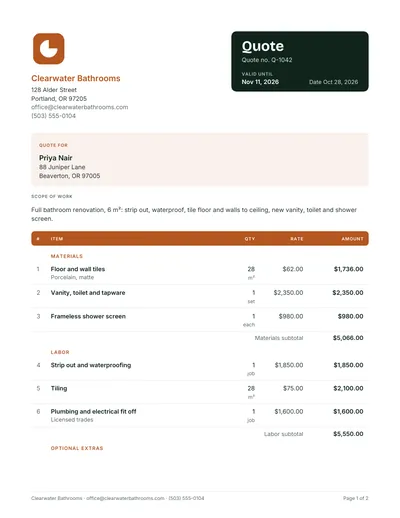
Group line items, add optional extras and set a deposit, then download the PDF.
Questions about winning quotes
What is a good quote win rate?
There is no single good number. It depends on your trade, where your leads come from and how many businesses each customer asks. Track your rate by lead source, because the same figure means something different for referrals and for cold inquiries. The useful comparison is your own rate, month by month, by count and by value.
Should I lower my prices to win more quotes?
Usually not as a first step. Lower prices win some jobs but cut the profit on every job, including the ones you would have won anyway. Fix speed, clarity, options and follow up first. If price is still the reason you lose one kind of job, review your costs for that work rather than discounting across the board.
How quickly should I send a quote?
Within a day or two of the visit for most jobs, and the same day for small or urgent work. If you need supplier prices first, tell the customer when to expect the quote. A late quote quietly suggests the work might run late too.
Do good, better, best options really help?
They change the question in the customer’s mind from whether to hire you to which option to choose, and they let customers with different budgets say yes. Keep it to two or three options, make the differences clear, and only offer options you would be happy to deliver at those prices.
How can I compete with cheaper quotes?
Make the comparison fair. Itemize your quote and state your exclusions, so the customer can see what a cheaper quote leaves out. Mention your warranty, timeline and how you handle surprises. Some customers will still pick the lowest price, and that is fine: those are not the jobs to chase.
Should I charge for quotes to filter out time wasters?
For small, routine jobs a free quote is normal and a fee may cost you work. For large or design-heavy jobs, a paid consultation, deducted from the job price if they go ahead, can filter inquiries and pay for your time. Asking about budget and timing at the first contact is a lighter filter that suits most jobs.