Written estimate law US and what it asks of you
No single US law covers written estimates. See what the FTC Cooling-Off Rule means for sales at a customer’s home, which state rules add to it, and start your estimate.
- Sales tax, a deposit line and a valid until date
- State examples for auto repair and home improvement, clearly marked
- A free estimate you can build online
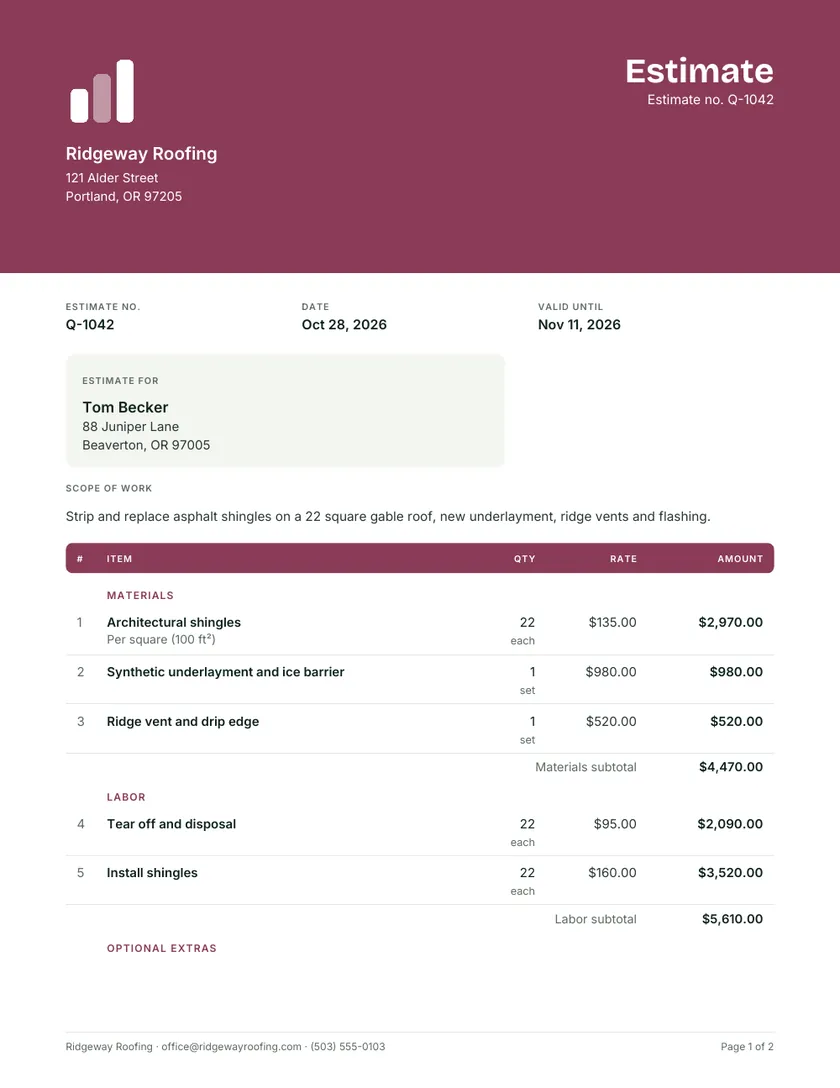
An estimate in the US is your forecast of the price, and once a customer signs it, or a contract built on it, you can be held to it. No federal law requires every estimate to be written, but the FTC Cooling-Off Rule gives three business days to cancel many home sales, and states such as California and New York set their own contract, cancellation and deposit rules.
Estimates in the United States at a glance
There is no single written estimate law in the US. The FTC Cooling-Off Rule covers some sales made at a customer’s home, and each state adds its own rules for auto repair, home improvement and contractor deposits. This page sets out those rules from official sources, with state examples clearly marked, and gives you a free US estimate template with sales tax, a deposit line and a valid until date. The estimate template USA businesses can start from adds sales tax, a deposit line and a valid until date.
- Usual title
- Estimate, or Quote or Bid for a fixed price
- Federal cancellation rule
- 3 business days for covered home sales
- Tax on the estimate
- State and local sales tax, where it applies
- Business ID
- EIN, plus any state license number
- Paper and dates
- US Letter, Oct 28, 2026
- Spelling
- American: labor, color
Is an estimate legally binding in the US?
On its own, an estimate is a forecast of the price, not a promise. What binds you is what the customer accepts: a signed estimate, a contract or a work order. No single federal law covers estimates. The FTC regulates certain home sales and each state sets the rest, so one document can carry different duties in California and New York.
State rules can make an estimate firmer than its name suggests. California home improvement contracts, for example, must handle any price or scope change through a written change order signed by both sides before the change is made.
The working rule for any trade: call the document an estimate only when the price can genuinely move, say what would move it, and get written approval before you go over it. If you can hold the price, call it a quote or a bid. Our guides on the difference between a quote and an estimate and whether a quote is legally binding cover the wording in more depth.
The FTC Cooling-Off Rule and estimates signed at home
The FTC Cooling-Off Rule lets a buyer cancel certain sales made at their home, or at a temporary location away from the seller’s permanent place of business, until midnight of the third business day after the sale. Saturdays count as business days. Sundays and federal holidays do not.
- Thresholds. Sales at the buyer’s home are covered from $25, and sales at temporary locations from $130, a level that took effect on March 13, 2015.
- Repairs the customer asked for. A sale made because the customer asked you to visit to repair or maintain their personal property is not covered, but anything extra you sell on that visit is.
- Other exclusions. Sales needed to meet an emergency, sales made entirely online, by mail or by phone, and sales after negotiations at your permanent place of business.
- Paperwork. At the time of sale you must tell the buyer about the right to cancel and give two copies of a cancellation form, plus a dated contract or receipt showing your name and address that explains the right, in the same language as the sales presentation.
- Refunds. After a cancellation you have 10 days to refund the money, return any check the buyer signed and return any trade-in.
So an estimate signed at a kitchen table after a door knock can be cancelled. Note who asked for the visit, and hold off ordering special materials until the window closes.
State example: written estimates for auto repair in California
Auto repair is where estimate rules get most detailed, and California is a clear example. Its Bureau of Automotive Repair says a shop must give the customer an estimate showing the expected cost of the work, and the customer must authorize the repairs before the shop can begin. Treat this as one state’s rule, not a national one.
- Authorization can be given verbally, in writing or electronically, for example by email or text.
- If the shop finds more problems after starting, it must contact the customer, who must authorize any additional repairs.
- A teardown to diagnose the problem may be charged even if the customer then declines the repair, so say so up front.
- The final invoice must list the shop’s name, address and license number, every repair including free work, every part with a note of whether it is used, reconditioned or rebuilt, and the totals for parts and labor.
- The customer can ask for replaced parts back, and should ask before approving the work.
Other states run their own programs, so check your regulator. Our auto repair estimate template has separate lines for diagnosis, parts and labor.
Home improvement estimate rules: California and New York
Home improvement is the other area where states step in. California and New York both apply their rules to jobs above $500, give the homeowner a short window to cancel, and control how much money you can take before the work is done. These are state examples, not federal rules, and other states differ.
| Rule | California (CSLB) | New York (Attorney General) |
|---|---|---|
| Written contract | Required for all home improvement projects over $500 | The law covers most improvements costing more than $500; contracts must be in writing, legible and in plain English, with a copy given before work starts |
| Right to cancel | Three days, or five days for buyers aged 65 and older, unless the contract was negotiated at the contractor’s place of business | Until midnight of the third business day after signing, in writing |
| Money up front | Down payment no more than $1,000 or 10% of the contract price, whichever is less | Payments before substantial completion go into an escrow account at a New York bank within five business days, or a bond is delivered within ten business days |
| Progress payments | Payments cannot exceed the value of the work performed | Any schedule must bear a reasonable relationship to the work done |
| What the contract shows | Products and work in detail, payment schedule, permits, completion date, license number | Work and materials with brands and model numbers, price, approximate start and completion dates |
California also has a service and repair contract for urgent work under $750, where the right to cancel ends once the contract is signed and work starts. In other states, check the contractor licensing board or attorney general.
What to put on a US estimate
The FTC’s advice to homeowners doubles as a checklist for contractors. A written estimate should describe the work, the materials, the completion date and the price. The contract that follows should add your name, address, phone and license number, estimated start and completion dates, and a written statement of the customer’s right to cancel.
On the estimate
- Business name, address, phone and license number
- Customer name and job address
- Scope of work with line items for materials and labor
- Units and quantities: squares, ft², linear ft, hrs, each
- Sales tax on its own line, where it applies
- Estimated completion date
- Valid until date
Before work starts
- Signed acceptance or contract
- Payment schedule and deposit
- Who pulls permits
- How changes are approved in writing
- Notice of the right to cancel, where it applies
- Cleanup and debris removal
- Any labor or materials warranty, in writing
The FTC tells homeowners to compare several estimates, so an itemized one that explains your numbers beats a lump sum. The free estimate maker adds a low to high range when the price depends on what you find.
Sales tax and tax IDs on a US estimate
There is no national sales tax rate to print on an estimate. The SBA notes that sales tax, like income and property tax, can vary significantly from place to place, and that the need for a state tax ID number depends on whether your business must pay state taxes. Check your state revenue department before you add tax to a job.
Your EIN is your business’s federal tax ID number. Commercial customers may ask for it when setting you up as a vendor, so you can print it next to your state license number.
The quote maker’s US preset takes your local rate and shows prices with tax added or included. The estimate template for USA jobs comes in Word, Excel and PDF from the quote template library, and the roofing estimate template shows a filled example.
Deposits, payment terms and how long an estimate stays open
No federal rule caps contractor deposits. The FTC tells homeowners not to pay the full amount up front, notes that some states limit the size of a down payment, and advises never making the final payment until the work is finished. California’s cap of $1,000 or 10% of the contract price, whichever is less, is one example of a state limit.
We found no federal or state rule that fixes how long an estimate stays valid. Thirty days is a common choice, shorter when lumber, shingles or copper are moving. Print a valid until date so an old price cannot be accepted months later; our guide to quote validity periods has sample wording.
Sources
General information, not legal advice.
- FTC Consumer Advice: Buyer’s Remorse, the FTC’s Cooling-Off Rule May Help
- FTC: FTC Approves Changes to Cooling-Off Rule
- FTC Consumer Advice: How To Avoid a Home Improvement Scam
- California Bureau of Automotive Repair: Auto repairs
- California Contractors State License Board: Learn about home improvement contracts
- California Contractors State License Board: Home improvement contracts, warnings and exceptions
- New York State Attorney General: Home improvement fact sheet
- U.S. Small Business Administration: Get federal and state tax ID numbers
US estimate questions
Short answers based on the official sources listed on this page. General information, not legal advice.
Is an estimate legally binding in the US?
On its own an estimate is a forecast, but once the customer signs it, or a contract based on it, you can be held to its terms. Some states go further: in California an auto repair shop needs the customer’s authorization before work starts and again before any additional repairs. Get written approval before you exceed it.
Can a contractor charge more than the estimate?
Only with the customer’s agreement, and the details depend on the state and the trade. California auto shops must get authorization for any additional repairs, and California home improvement contractors must use a written change order signed by both parties before changing the price or scope.
Does the 3 day cancellation rule apply to contractor estimates?
It can. The FTC Cooling-Off Rule covers sales of $25 or more made at the buyer’s home, with cancellation allowed until midnight of the third business day. It does not cover a repair or maintenance visit the customer asked for, though extras sold on that visit are covered. California and New York also give home improvement customers their own cancellation rights.
How much deposit can a contractor ask for?
It depends on the state. California caps the down payment on home improvement work at $1,000 or 10% of the contract price, whichever is less. New York requires advance payments to go into escrow at a New York bank or be covered by a bond. The FTC advises homeowners never to pay the full amount up front.
Do I add sales tax to an estimate?
If your state and local rules tax the work, show the tax on the estimate so the total matches the invoice. Rates vary from place to place, so check with your state revenue department. The quote maker lets you enter your local rate and show prices with tax added or included.
How long should a written estimate be valid?
No national rule sets a period. Thirty days suits most trades, with 7 or 14 days when material prices are moving. Print the valid until date on the estimate.