Software development quotation for a build on budget
Pricing an app that does not exist yet invites scope creep. Break the delivery tracker into screens with hours against each, starting with paid discovery and ending with launch.
- Wireframes, driver screens, dashboard and testing by the hour
- Hours and rate multiplied out for each feature
- Free download you can reuse for every client
What a software development estimate should cover
A software development quotation has to price something that does not exist yet, so it works best when the build is broken into features with hours against each. This template starts with paid discovery, lists every screen or module at an hourly rate, adds testing and launch, and offers support as an optional retainer. Load the sample, or download Word, Excel or PDF.
A software development estimate should show the client what is being built, how long each part takes and what you have assumed. List the features with hours, state the technology and hosting, and explain how changes are handled once the build is under way.
- Discovery and requirementsWorkshops, user stories and wireframes, priced as a fixed first phase. What it produces becomes the basis for the build price.
- Features with hoursEach screen, module or integration with its estimated hours, so the client can drop or defer features to fit a budget.
- Technology and hostingThe stack, where it will be hosted and who pays the cloud bill. Hosting and third party API fees are monthly costs and belong outside the build total. A simple marketing site suits a website design quotation better, and office servers belong on an IT services quote.
- Testing and launchAutomated and manual testing, a staging environment, app store submission if needed, and support on launch day.
- AssumptionsWhat the numbers rely on, such as the client supplying content, an outside API behaving as documented, or a fixed number of user roles.
- Change requestsHow new features are priced once the build starts, normally as a written change with hours and cost agreed before work begins.
- Code ownershipWhen the intellectual property and the code repository pass to the client, which is usually on final payment.
- Warranty and supportA bug fix period after launch, such as 30 days, followed by an optional retainer for updates and improvements.
Sample software development quote with example prices
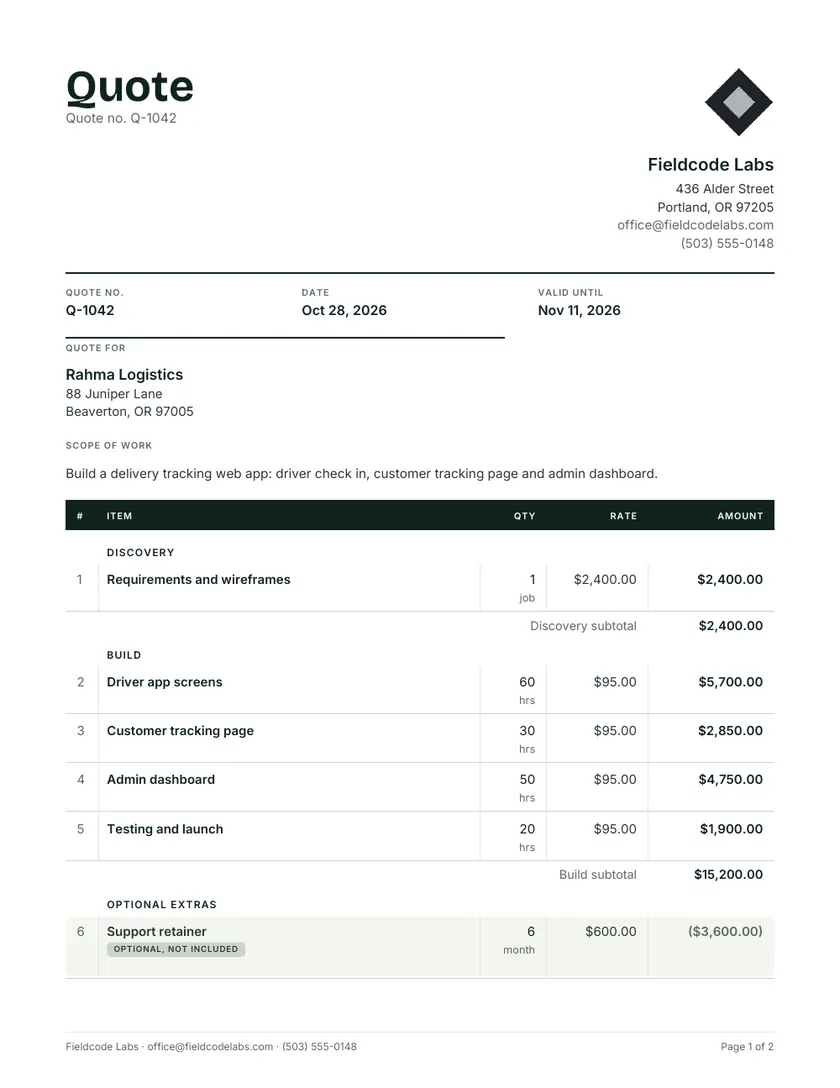
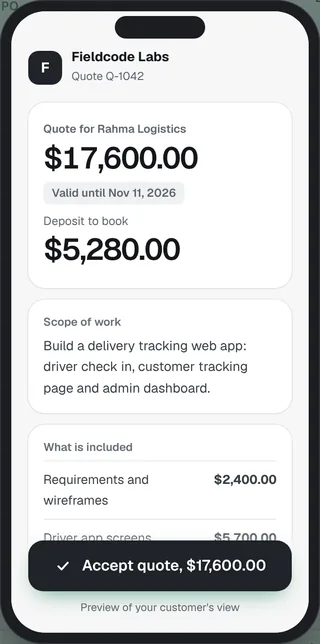
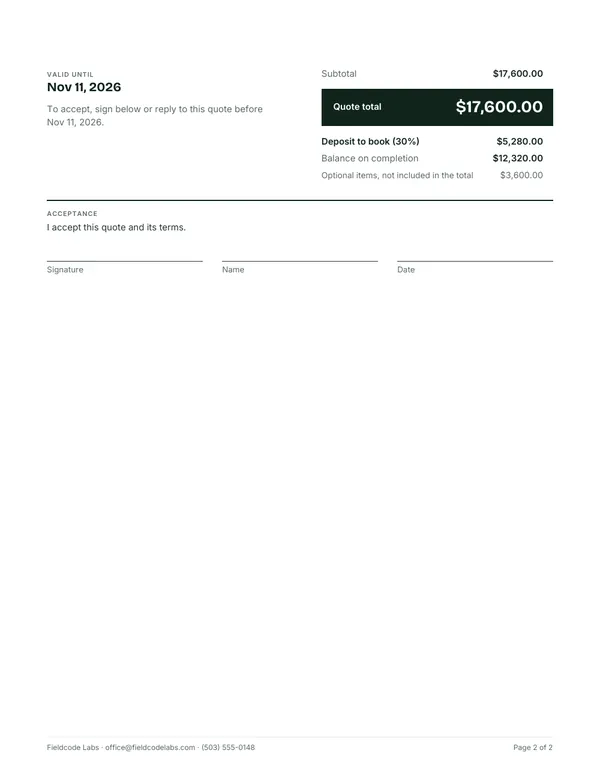
Fieldcode Labs is quoting Rahma Logistics for a delivery tracking web app. Discovery is a fixed $2,400 for requirements and wireframes. The Build group lists the driver screens (60 hours), the customer tracking page (30), the admin dashboard (50) and testing and launch (20), all at $95 an hour. The subtotal is $17,600. A six month support retainer at $600 a month is optional, and the deposit is 30%. All figures are examples.
| Item | Group | Qty | Rate | Amount |
|---|---|---|---|---|
| Requirements and wireframes | Discovery | 1 job | $2,400.00 | $2,400.00 |
| Driver app screens | Build | 60 hrs | $95.00 | $5,700.00 |
| Customer tracking page | Build | 30 hrs | $95.00 | $2,850.00 |
| Admin dashboard | Build | 50 hrs | $95.00 | $4,750.00 |
| Testing and launch | Build | 20 hrs | $95.00 | $1,900.00 |
| Support retainer | Optional extras (optional) | 6 month | $600.00 | ($3,600.00) |
| Subtotal before tax | $17,600.00 | |||
| Optional extras, not in the total | $3,600.00 | |||

6 lines are filled in, from requirements and wireframes to support retainer. Put in your own software development rates, then download the PDF.
How to price software development
Software is priced as a fixed price per phase, as time and materials at an hourly or daily rate, or as a monthly retainer. Many developers combine them: fixed price discovery, an estimated range for the build, and a retainer once the product is live.
- Fixed price per phaseA firm price for a phase with a clear output, such as discovery or a defined first release. It works when the requirements are written down and signed off.
- Time and materialsHours or days at an agreed rate, billed as worked, with the estimate as a guide. Fairer when the client expects requirements to shift during the build.
- Estimate rangeLow and high hours for each feature, so the client can see the uncertainty rather than a falsely precise single figure.
- RetainerA monthly fee for a set number of hours of maintenance and small features. Say whether unused hours carry over or lapse.
The fixed price vs time and materials guide explains when each suits a build. When scope is still moving, show a low to high range with the estimate maker.
Worked example: costing a booking feature set with contingency
A client wants five features added to an existing app. Here is the estimate built from user stories at an example rate of $95 an hour.
- User storiesLogin and roles 16 hrs, booking form 24 hrs, payment integration 20 hrs, notifications 12 hrs, admin reports 28 hrs: 100 hrs in total.
- TestingAdd 20% of build time for testing: 20 hrs.
- Project managementAdd 10% of build time for planning and client calls: 10 hrs. Total: 100 + 20 + 10 = 130 hrs.
- Low figure130 hrs × $95 = $12,350.
- High figureAdd 15% contingency for unknowns in the payment provider’s API: 130 × 1.15 = 149.5 hrs, and 149.5 × $95 = $14,202.50. The quote reads $12,350 to $14,202.50.
Integrations with outside systems, the number of user roles and how settled the requirements are widen or narrow the range more than the screen count does.
Inclusions and exclusions for a software build
Usually included
- Discovery workshop, user stories and wireframes
- Build of the listed features
- Testing on a staging environment
- Deployment to production
- A 30 day bug fix period after launch
- Handover of source code on final payment
Excluded unless priced
- Hosting, cloud and third party API fees
- New features requested after sign off
- App store developer account fees
- Content entry and data migration
- Maintenance after the warranty period
Software quoting mistakes
- Giving a single fixed figure before discovery, when nobody yet knows what the admin side needs.
- Leaving testing out of the hours, then squeezing it into the final week.
- Forgetting hosting and API costs, so the client is caught out by a monthly cloud bill.
- Having no written process for change requests, so new features slip in at the original price.
- Not stating when the source code and intellectual property pass to the client.
- Ending the quote at launch, with no bug fix period and no support option.
Software estimate questions
How do you write a software development quotation?
Run or price a discovery phase first. Then list every feature with hours, add testing, project management and launch, and multiply by your rate. State the stack, hosting, assumptions, change process, ownership terms and payment milestones. The estimate writing guide shows how to present a range.
Should software be quoted at a fixed price or hourly?
A fixed price works for a well defined phase with signed requirements. Hourly or daily billing is fairer when the client expects to change direction. A common mix is fixed price discovery, an estimated range for the build, and monthly billing for support.
How do I estimate hours for a software project?
Break the work into user stories small enough to estimate in hours, compare them with similar past builds, then add time for testing, project management and integration risk. Give a low and a high figure rather than one number while the requirements are still settling.
What payment terms suit software projects?
Milestone payments are common: a deposit to start, then payments at the end of discovery, at a beta release and at launch. The sample takes 30% up front. Each milestone can become an invoice through quote to invoice.
Who owns the code in a software project?
Your quote or contract decides. Clients usually expect the code and intellectual property to pass to them once they have paid in full, while the developer keeps reusable libraries and tools built before the project. Write this down before any code is written.
What is a support retainer?
A monthly fee for maintenance after launch: security updates, bug fixes and small changes up to a set number of hours. The sample offers it as an optional $600 a month for six months. Layouts for other service businesses sit in the quote template library.