Quote vs invoice and the right time for each
A quote offers a price before work starts, and your customer owes nothing until they accept and you bill. An invoice asks for payment. Follow one job through to receipt.
- Quote, invoice and receipt compared in one table
- One job followed from quote to paid, with figures
- How to turn a quote into an invoice without retyping
By WhizQuote Editorial · 7 minute read
A quote is an offer sent before work starts, saying what you will do and for how much, valid until a set date. An invoice is a request for payment sent after the work, or at a payment stage, with a due date. A quote is not an invoice: the customer owes nothing until they accept the quote and you bill them.
The difference between a quote and an invoice
A quote asks whether the customer wants the work at a stated price. An invoice tells them what they owe and by when. The quote opens the deal and can be refused; the invoice records a debt under a deal already made. Everything else, the layout, the line items, the totals, can look almost identical, which is why the two get confused.
- A quote is a written offer to do described work for a stated price until a valid until date. Accepting it usually creates a contract.
- An invoice is a bill for work done or for an agreed stage, such as a deposit. It has a due date and payment details.
- A receipt is proof that payment was received. It closes the loop.
Quote vs invoice vs receipt compared
The table sets the three documents side by side. Read down a column to see what one document does; read across a row to see how one detail, such as the key date or the number series, changes from quote to invoice to receipt. Tax rules on invoices differ by country, so check your country page for what yours must show.
| Detail | Quote | Invoice | Receipt |
|---|---|---|---|
| Purpose | Offer a price | Request payment | Confirm payment |
| Sent | Before work | After work or at a stage | After payment |
| Effect | Contract once accepted | Records an amount owed | Records an amount paid |
| Money owed on receipt | No | Yes, by the due date | No, already paid |
| Key date | Valid until | Due date | Date paid |
| Number series | Q-1042 | INV-2214 | RC-0871, or invoice marked paid |
| Optional items | Shown for the customer to choose | Only the ones chosen | Not shown |
| In your books | Not recorded as a sale | Recorded as a sale | Records cash received |
Is a quote the same as an invoice
No. They often share a template, a logo and a list of line items, but they do different legal and accounting jobs. Changing the heading from Quote to Invoice is not enough: the invoice needs its own number and date, a due date and payment details, and it should reflect what was actually done, including changes and payments already received.
A few situations blur the line:
- Deposit invoices. After acceptance you invoice the deposit. That invoice exists because the quote was accepted, not instead of it.
- Proforma documents. In trade and export, a proforma looks like an invoice but is sent before the sale is final. See proforma invoice vs quotation.
- Estimates. An estimate is a forecast, neither a firm offer nor a bill. The quote vs estimate guide covers it.
From quote to invoice to receipt, with real numbers
Here is one small renovation job followed through every document. The quote sets the price, the deposit invoice books the start date, a variation adds work, the final invoice brings everything together and deducts what was already paid, and a receipt confirms the balance arrived. Tax is shown at 10% as an example rate.
| Document | What it shows | Amount |
|---|---|---|
| Quote Q-1042 | Labor 16 hrs × $72 = $1,152; materials $2,760; disposal $288; subtotal $4,200; tax $420 | $4,620.00 |
| Deposit invoice INV-2207 | 25% of $4,620 to book the start date | $1,155.00 |
| Variation V-01 | Extra shelving, $300 plus $30 tax, signed before the work | $330.00 |
| Final invoice INV-2214 | $4,620 + $330 = $4,950, less deposit paid $1,155 | $3,795.00 |
| Receipt RC-0871 | Balance received by bank transfer | $3,795.00 |
The customer paid $1,155 + $3,795 = $4,950 in total, which matches the quote plus the signed variation. Every figure on the final invoice traces back to a document they agreed to, so there is nothing to dispute.
What changes when a quote becomes an invoice
Converting an accepted quote into an invoice is mostly about removing what belonged to the offer and adding what belongs to a bill. Work through the list below each time, or use software that does it for you, so nothing from the quote stage lingers on a document asking for money.
Remove or change
- Heading: Quote becomes Invoice
- Quote number becomes an invoice number
- Valid until date comes off
- Optional items the customer did not choose
- Acceptance and signature block
Add
- Invoice date and due date
- Approved variations by number
- Deposit and progress payments received
- Payment details: bank, card link or other method
- Any tax invoice wording your country requires
Keep the quote number on the invoice as a reference line, such as “Ref: Q-1042”. The quote numbering guide explains how to run separate series without mixing them.
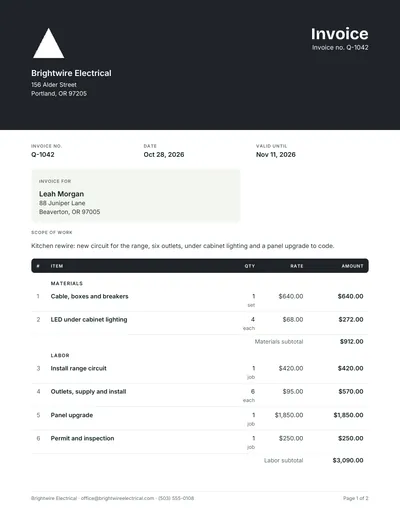
A quote with a clear deposit line and valid until date makes the invoice easy later.
Where a receipt fits
A receipt is the customer’s proof that they paid. For card and bank payments, many businesses simply send the invoice again marked Paid with the date and method, and that serves the purpose. For cash, give a separate receipt with its own number, the amount, the date and what it was for.
Common mix-ups between quotes and invoices
The same handful of mistakes turn up again and again, and each one costs either money or goodwill. Most come from using a single document for two jobs, or from forgetting that the customer sees the quote and the invoice side by side when the bill arrives.
- Sending an invoice when the customer asked for a price, which reads as a demand for money they never agreed to.
- Billing before the quote is accepted.
- Using one number series for quotes and invoices, so gaps and duplicates appear in your records.
- Forgetting to deduct the deposit on the final invoice.
- A final total that differs from the quote with no variation to explain it.
- Leaving declined optional items on the invoice.
Moving from quote to invoice without retyping
Retyping a quote as an invoice is where totals drift and deposits get forgotten. The cleaner route is to build the quote once and carry it forward. Our free quote maker produces the quote as a PDF; the next step depends on how many jobs you run each month.
- Occasional invoices: the free invoice generator at InvoiceMakerHQ, our sister site.
- Regular work: WhizInvoice, our own app, sends and tracks quotes and invoices, turns an accepted quote into an invoice in one click and tracks payment. You can start free.
- More detail: the quote to invoice page walks through the switch step by step.
Quote and invoice questions
Can a quote be used as an invoice?
Not as it stands. An invoice needs its own number, an invoice date, a due date and payment details, and it should reflect the work actually done, including variations and deposits paid. Start from the accepted quote, but turn it into a proper invoice before you ask for payment.
Do I have to pay a quote?
No. A quote is an offer, and you owe nothing for receiving one. Once you accept it you have agreed to pay the quoted price for the work, but payment is normally due when the business invoices you, either for a deposit or after the work.
Which comes first, a quote or an invoice?
The quote. It comes before the work so the customer can agree the price. Invoices follow: sometimes a deposit invoice straight after acceptance, then progress invoices for longer jobs, and a final invoice on completion.
Should the final invoice match the quote exactly?
It should match the accepted quote plus any approved variations, less payments already made. If the number is different, the customer should be able to see why from signed variations or agreed changes listed on the invoice.
Is an estimate an invoice?
No. An estimate is an approximate price given before work, like a quote but less firm. An invoice is a bill for work done. If you worked from an estimate, the invoice shows the actual cost, which should be close to the estimate unless you agreed changes.