Fixed price vs time and materials for the job you are pricing
The real choice is who carries the risk when the job changes, you or your customer. One hidden repair, priced three ways, shows how each contract plays out.
- One repair priced three ways under three outcomes
- Quote wording for fixed, hourly and cost plus contracts
- How to mix contract types on a single quote
By WhizQuote Editorial · 9 minute read
Use a fixed price when you can see and measure the whole job, because the customer gets certainty and you keep any savings. Use time and materials when the extent is unknown, such as repairs behind walls or under floors, so you are paid for the hours and materials actually used. Cost plus charges actual costs plus an agreed fee.
Three ways to price the same job
Fixed price, time and materials, and cost plus are three ways to agree what a customer will pay. They differ in when the final number is known and in who absorbs the difference when the hours or materials run over the plan. Each has its place, and one business can use all three, job by job.
- Fixed price
- One total for a defined scope of work, whatever the job ends up costing you. Also called a lump sum.
- Time and materials
- Agreed hourly rates for the hours actually worked, plus materials at cost with a stated markup.
- Cost plus
- The actual cost of labor, materials and subcontractors, plus a fee, either a percentage or a fixed amount, that covers overhead and profit.
Side by side: what changes between the three
The table compares the three contract types on the points that matter most to both sides: when the final price is known, who carries an overrun, who keeps a saving, how much paperwork it takes and which jobs each one suits. Read across a row to see the trade off.
| Fixed price | Time and materials | Cost plus | |
|---|---|---|---|
| Final price known | Before work starts | At the end | At the end |
| Who carries an overrun | You | The customer | The customer |
| Who keeps a saving | You | The customer | The customer |
| Where your profit comes from | Whatever is left after costs | Built into each rate and the markup | The agreed fee |
| Paperwork | One quote, plus change orders for extras | Timesheets and receipts | Open books: every cost documented |
| Suits | A clear, measurable scope | Repairs and work of unknown extent | Large custom work with a changing design |
| Customer’s main worry | Paying for padding | An open-ended bill | Checking every cost |
One repair priced three ways
The same job looks very different under each contract once the work runs short or long. Here the job is replacing water-damaged subfloor under a bathroom, where the full extent is unknown until the old floor comes up. The plan is 16 hours of labor and $420 of materials.
- Fixed price: 16 hrs × $75 = $1,200, materials $420 × 1.15 = $483, plus a 15% contingency on both ($252.45), so $1,935.45, rounded to $1,935.
- Time and materials: $75 per hour worked, materials at cost plus 15%.
- Cost plus: labor at its cost of $48 per hour, materials at cost, plus a 30% fee for overhead and profit.
| Outcome | Hours and materials | Fixed price | Time and materials | Cost plus 30% |
|---|---|---|---|---|
| Goes well | 12 hrs, $350 | $1,935.00 | $1,302.50 | $1,203.80 |
| As planned | 16 hrs, $420 | $1,935.00 | $1,683.00 | $1,544.40 |
| Goes badly | 22 hrs, $560 | $1,935.00 | $2,294.00 | $2,100.80 |
On the fixed price the customer pays $1,935 whatever happens. If the job goes badly you absorb the $359 gap between that and the time and materials bill; if it goes well you keep a $632.50 difference. The contingency is the cost of certainty, which is why time and materials can be the fairer offer on an open-ended repair.
The cost plus column is lower only because of the 30% fee chosen for this example. Set your own fee so it covers your real overhead per hour and the profit you need, or cost plus becomes the cheapest way to work for nothing.
When a fixed price is the right call
Quote a fixed price when you have seen the whole job, can measure it and have priced similar work before. Customers like knowing the number in advance, it is easy to compare, and you keep the upside when the crew works efficiently. The risk sits with you, so the scope and exclusions have to be tight.
- New installations you can measure, such as a fence, a deck or a repaint.
- Like for like replacements where nothing hidden is disturbed.
- Work you have timesheets for from past jobs.
- Jobs where the customer has chosen every finish and fitting.
The change order clause is what makes a fixed price safe. The guide to variations and change orders shows how to price extras, and the change order template gives you the form.
How a time and materials contract works
A time and materials contract bills the hours actually worked at agreed rates, plus materials at cost with a stated markup. The customer pays for what the job really took, and you are covered when it grows. In return you keep accurate timesheets and receipts and tell the customer the running total as you go.
- State an hourly rate for each role, such as $75 for a lead and $55 for a helper.
- Say how travel, call-outs and minimum charges work.
- Give the materials markup as a percentage.
- Agree how often you invoice: weekly on longer jobs, at completion on short ones.
- Offer an estimated range and a ceiling the total will not pass without approval.
A range is easier to accept than an open rate sheet. The estimate maker shows a low to high range on the page, and quote vs estimate explains how customers read each one.
Fixed price vs cost plus: when open books make sense
Cost plus suits large or custom work where the design keeps changing and nobody can fix the scope in advance. The customer sees every cost and pays an agreed fee on top, so trust and record keeping matter more here than anywhere else. Compared with a fixed price, you give up the upside to remove the downside.
- Define what counts as cost. Labor at a stated cost rate, materials, subcontractors, rentals and permits. Overhead belongs in the fee, not in the costs.
- Choose the fee type. A 15% fee on $60,000 of costs is $9,000; if costs rise to $70,000 it becomes $10,500. A fixed fee of $9,000 stays put, so you earn nothing extra when costs climb, which customers tend to trust more.
- Consider a ceiling. A guaranteed maximum price caps what the customer pays, with savings below the cap shared or returned as agreed.
- Keep every receipt. The customer is entitled to check what was agreed.
A 30% fee is a markup on cost, not a margin: it works out to 23.1% of the price. The markup vs margin guide covers the conversion.
Mixing contract types on one quote
A quote does not have to use one method for everything. A practical pattern is a fixed price for the parts you can see and an hourly rate or an allowance for the parts you cannot. The customer gets certainty on most of the price, and you are not guessing at what lies under the floor.
In the quote maker, the subfloor repair can go in as an optional item the customer can tick. It shows as Optional and stays out of the total until it is chosen, so the headline price is honest and the possible extra is in plain sight.
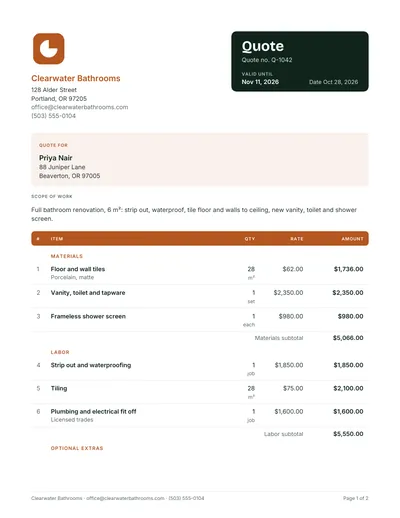
Price the work you can see as normal lines and add the uncertain part as an optional item the customer can tick.
Checklist: choosing the contract type
Run through these questions before you write the price. If most answers point the same way, the choice is made for you. If they split, use a fixed price for the clear parts and time and materials for the rest, and say so plainly on the quote so there is no surprise later.
- Have you seen and measured the whole job? Yes points to a fixed price.
- Could opening up a wall, floor or roof reveal more work? Use an hourly rate or an allowance for that part.
- Has the customer chosen every finish and fitting? If not, use allowances or cost plus.
- Do you have past hours for this kind of work? Without them, a fixed price is a guess.
- Will this customer accept a bill that is not known in advance? Some will not, whatever the logic.
- Can you keep daily timesheets and receipts? If not, avoid time and materials and cost plus.
Whichever you pick, build the numbers the same way: labor cost, materials, overhead and profit, as set out in how to price a job.
Contract type questions
What is a time and materials contract?
It is an agreement where the customer pays for the hours actually worked at set hourly rates, plus materials at cost with an agreed markup. The final price is known only at the end. It suits repairs and jobs whose extent cannot be seen in advance, and it works best with an estimated range and a ceiling.
Is fixed price or time and materials better for the customer?
It depends on how well the job can be defined. A fixed price gives certainty but includes a contingency the customer pays even when nothing goes wrong. Time and materials has no padding, so it is usually cheaper when the job goes smoothly and dearer when it does not.
What is a not to exceed clause?
It is a ceiling on a time and materials or cost plus job: the total will not pass a stated amount without the customer’s written approval. It gives the customer a limit and gives you a clear point to stop and talk, rather than a dispute when the invoice arrives.
Can a fixed price change after it is accepted?
Only through an agreed change, such as extra work the customer asks for or conditions your exclusions covered. Price the change in writing and get it approved before doing the work. The guide on whether a quote is binding explains why.
What is the difference between cost plus and time and materials?
Time and materials bills labor at a charge rate that already includes overhead and profit. Cost plus bills labor at what it actually costs you and adds a separate fee for overhead and profit. Cost plus needs open books and full receipts; time and materials needs timesheets and a materials summary.
How do I invoice a time and materials job?
Invoice at the agreed intervals with the hours by person and date, the materials with their markup, and the running total against the estimate. On short jobs one invoice at completion is enough. The quote to invoice page shows how to carry the quote details across.