Quotation template UK you can stand behind
An accepted quote can bind you in a way an estimate does not. Start with VAT at 20% in GBP, then see the 14 day cancellation rule for off premises work.
- VAT at 20%, GBP and your VAT number in place
- What the Consumer Rights Act adds to every job
- Free online, no sign up and nothing to install
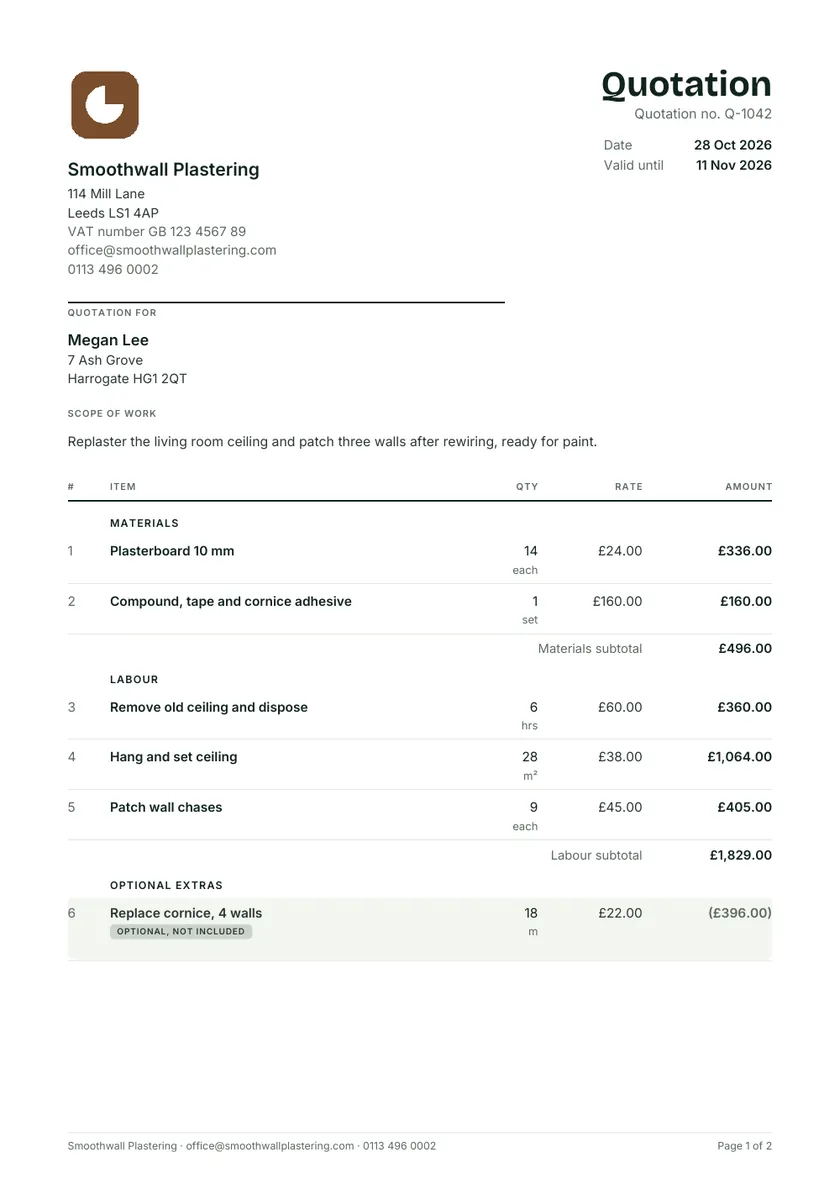
In the UK a quote, also called a quotation or fixed estimate, is a promise to do work at an agreed price, and once accepted you cannot charge more without a good reason such as agreed extra work. An estimate is a best guess, and the final bill must be reasonable. Show VAT clearly, state how long the price is valid, and give cancellation information for off-premises contracts.
Quotations in the UK at a glance
A free quotation template for UK trades and service businesses, with VAT at 20%, GBP and your VAT number in place. Under it is what UK consumer law says about quotes: when a builders quote binds you, how an estimate differs, the 14 day cancellation right for work agreed in the customer’s home, and how VAT should appear on the total. Use it for a builders quote: UK VAT and cancellation rules work the same way.
- Usual title
- Quotation or quote; Estimate if not fixed
- Tax on the quote
- VAT at 20%, with 5% and 0% for some supplies
- Register for VAT
- Taxable turnover over £90,000
- Cooling off
- 14 days for off-premises contracts
- Deposit guidance
- Citizens Advice: no more than 25%
- Paper and spelling
- A4, British spelling
Is a quote legally binding in the UK?
Yes, once the customer accepts it. Citizens Advice defines a quote, sometimes called a quotation or fixed estimate, as a promise to do work at an agreed price. The trader cannot charge more than quoted unless there is a good reason, such as extra work the customer agreed to. Higher costs since the quote was given do not count.
Mistakes land on you as well. If an error was not obvious to the customer when they received the quote, Citizens Advice says they have a legal right to get the work done for the price in the quote. Check quantities and arithmetic before you send, because a missed wall or a wrong area in m² is your loss, not theirs.
The Consumer Rights Act 2015 reaches beyond the price. Under section 50, what you say or write about the service is treated as a term of the contract if the consumer takes it into account when deciding to go ahead. A promised start date, a named product or “two coats” on the quotation are all things you will be held to. The guide on whether a quote is legally binding goes further.
Quote vs estimate: the legal difference in the UK
The legal difference is price certainty. A quote is a fixed price. An estimate is the trader’s best guess at what the work will cost, and Citizens Advice says the final price should be reasonable. The law does not define reasonable, so trader and customer have to agree it, looking at the original estimate, any changes and events outside the trader’s control.
Section 51 of the Consumer Rights Act 2015 backs this up. Where the contract does not fix a price or say how it will be fixed, the consumer must pay a reasonable price for the service, and no more. What is reasonable is a question of fact.
| Question | Quotation | Estimate |
|---|---|---|
| Is the price fixed? | Yes, once accepted | No, it is a best guess |
| Can the bill go up? | Only for a good reason, such as agreed extra work | Yes, but the final price must be reasonable |
| Do higher material costs justify more? | No | Agree it with the customer |
| Best suited to | Defined jobs, such as skimming a room | Unknown work, such as hidden damp or old wiring |
If you need room to move, call the document an estimate and list what could change the price. The quote vs estimate guide has wording for both.
What a builders quote in the UK should include
Citizens Advice tells customers to get written quotes from at least three traders, and says a good quote shows a fixed total price rather than a daily rate, a breakdown of the work and materials, how long the price is valid for, whether it includes VAT, and when the price can go up. Match that list and your quote reads as the safe choice.
- Fixed total: one figure for the job. If you work on a day rate, multiply it out for the customer.
- Breakdown: labour, materials, skip hire and making good on separate lines.
- Validity: a valid until date you can hold, such as 14 or 30 days.
- VAT: say plainly whether the price includes VAT, and show your VAT number if registered.
- Price changes: the price only changes if the customer agrees extra work, ideally in writing.
- Dates: if you fix no time, section 52 of the Consumer Rights Act implies the work will be done within a reasonable time, so name a start and finish.
A worked example for skimming one room, with example prices only:
| Line | Amount |
|---|---|
| Skim walls and ceiling, 2.5 days at £240 | £600.00 |
| Materials: board, multi-finish, angle beads | £140.00 |
| Waste removal | £60.00 |
| Subtotal | £800.00 |
| VAT at 20% | £160.00 |
| Total including VAT | £960.00 |
The plastering quote template has a fuller set of lines, including optional extras the customer can tick.
VAT on UK quotations
The standard rate of VAT is 20%, with a reduced rate of 5% and a zero rate for some goods and services. You must register when your taxable turnover for the last 12 months goes over £90,000, or when you expect it to go over £90,000 in the next 30 days. Below the threshold, registration is voluntary.
For household customers, show the VAT inclusive total. The Competition and Markets Authority’s price transparency guidance says that in an invitation to purchase you must give the customer the total price, and it names tax, like VAT, as a mandatory charge that belongs in it. Hiding fees or taxes until later in the purchase is illegal drip pricing, so a small “plus VAT” note under a consumer total is a risk you do not need.
Trade work can differ. The VAT domestic reverse charge must be used for most building and construction services supplied between businesses registered for VAT in the UK and reported within the Construction Industry Scheme. If you subcontract to a main contractor, check HMRC’s guidance before you word the VAT line.
The 14 day cancellation period for off-premises work
If you agree the work away from your premises, such as in the customer’s home, by phone or online, the customer usually has 14 days to cancel. For service contracts the period ends 14 days after the day the contract is entered into. Citizens Advice notes there is no cooling off period for work arranged at the trader’s own premises.
- Give the cancellation information. If you do not, the period is extended: it ends 14 days after the customer receives the information, or 12 months after it would normally have ended if they never do.
- Starting early. You must not start within the cancellation period unless the customer expressly asks, and for an off-premises contract that request must be on a durable medium, such as a signed form or an email.
- Cancelling after you start. The customer pays a proportionate amount for what was supplied up to the point they tell you. If they never made the request, or you did not give the required information, they pay nothing for it.
- Exceptions. Citizens Advice lists made to measure goods, and urgent repairs the customer called you in for, such as a burst pipe.
On quotations you sign in a customer’s kitchen, add a short cancellation notice and a box for “I want work to start within 14 days”.
Consumer Rights Act duties no quotation can drop
Every service contract with a consumer carries terms the Consumer Rights Act 2015 puts there automatically. Section 49 requires the trader to perform the service with reasonable care and skill. Where no time is fixed, section 52 requires a reasonable time, and where no price is fixed, section 51 limits the bill to a reasonable price.
Write the quotation to support these rather than fight them. A clear scope makes reasonable care and skill measurable, a start and finish window settles what a reasonable time means, and a fixed price takes section 51 out of play.
Deposits, stage payments and written contracts
Citizens Advice tells customers not to pay everything up front and, if a deposit cannot be avoided, not to agree to more than 25%. It also recommends paying in stages, so that problems can be put right before the final payment, and getting a contract in writing before giving the go ahead.
Asking for more than 25% puts you outside what customers are told to accept, so tie larger sums to stages that both sides can see: materials delivered, first fix done, finish coat applied. On the £960 example above, a 25% deposit is £240 with £720 due on completion. A signed quotation with clear terms can serve as the written contract on small jobs. The guide to deposits on quotes has more on wording.
Build yours in the formal quotation maker, or read the quote terms and conditions guide for more clauses.
Sources
General information, not legal advice.
- Citizens Advice: Problem with building work, decorating or home improvements
- Citizens Advice: Before you get work done on your home
- Citizens Advice: Cancelling building or decorating work
- legislation.gov.uk: Consumer Rights Act 2015, section 49
- legislation.gov.uk: Consumer Rights Act 2015, section 50
- legislation.gov.uk: Consumer Rights Act 2015, section 51
- legislation.gov.uk: Consumer Rights Act 2015, section 52
- legislation.gov.uk: Consumer Contracts Regulations 2013, regulation 30
- legislation.gov.uk: Consumer Contracts Regulations 2013, regulation 31
- legislation.gov.uk: Consumer Contracts Regulations 2013, regulation 36
- GOV.UK: VAT rates
- GOV.UK: Register for VAT
- GOV.UK (CMA): Providing clear and accurate information about prices
- GOV.UK: VAT domestic reverse charge for building and construction services
UK quotation questions
Short answers, with the official sources listed above. General information, not legal advice.
Is a quote legally binding in the UK?
Once accepted, yes. Citizens Advice describes a quote as a promise to do work at an agreed price, and the trader cannot charge more unless there is a good reason, such as agreed extra work. Under section 50 of the Consumer Rights Act 2015, things you say or write that the customer relies on also become terms of the contract.
What is the legal difference between a quote and an estimate in the UK?
A quote is a fixed price. An estimate is your best guess, and the final price must be reasonable. Where a contract fixes no price, section 51 of the Consumer Rights Act 2015 says the consumer pays a reasonable price and no more, which is a question of fact.
Can a builder charge more than the quote?
Only with a good reason, such as extra work the customer agreed to. Citizens Advice says a trader cannot charge more because their costs have gone up since the quote, and if a mistake in the quote was not obvious to the customer, the customer has a legal right to the work at the quoted price.
Do quotes have to include VAT?
Say clearly whether the price includes VAT. For consumers, the CMA’s price transparency guidance treats VAT as a mandatory charge that belongs in the total price, so quote the VAT inclusive figure. VAT is 20% at the standard rate, and you must register once taxable turnover goes over £90,000 in 12 months.
How much deposit should a builder ask for in the UK?
Citizens Advice advises customers not to pay everything up front and, if a deposit is needed, not to agree to more than 25%. It also recommends stage payments. Keep your deposit at or under that level and link further payments to visible progress.
Can a customer cancel after accepting a quote?
If the contract was made away from your premises, such as in their home, by phone or online, they usually have 14 days. If you start early at their express request and they then cancel, they pay a proportionate amount. If you never gave the cancellation information, the period can run for up to 12 months longer.