Paving quote for a lasting driveway
Customers cannot see the base under new pavers, so they compare on price alone. List excavation, road base and laying for the 48 m² driveway to show what yours includes.
- Pavers, road base, excavation and sealing on separate lines
- Quantities and rates add up to the total for you
- Free online, or as an editable Word file
What a driveway quote should include
A paving quote is mostly about what goes under the pavers. This template gives excavation, base materials, pavers and laying their own lines, so the customer can see the depth of base and the edge restraint they are paying for. The sample is a 48 m² concrete paver driveway, with sealing offered as an optional extra. Work on it in the quote maker or save it as a Word, Excel or PDF file.
Paving fails from the bottom up, so a driveway quote must show the excavation depth, the base material and how it is compacted, the bedding layer and the edge restraint, not only the paver. Add drainage, falls and truck access, and the customer can compare quotes on what matters.
- Area and patternArea in m² or ft², the laying pattern, such as herringbone for vehicle areas, and the cuts needed around curves, drains and meter boxes.
- Excavation and spoilHow deep you dig for the load the surface will carry, how much spoil that produces, and the trucking and tip fees to remove it.
- Base courseCrushed rock or road base thickness, placed and compacted in layers. A driveway needs a deeper base than a garden path.
- Bedding sandThe screeded sand layer under the pavers, about 1 in or 25 mm thick, kept even so the pavers settle flat.
- Paver productBrand or range, size, thickness and color. Driveways often use thicker pavers, such as 60 to 80 mm, than patios.
- Edge restraintA concrete haunch, plastic or steel edging, or a border course set in concrete, so the field cannot creep outward.
- Drainage and fallsThe fall away from the house and garage, a channel drain at the garage door if needed, and where the water goes once it leaves the paving.
- Jointing and compactionJointing sand swept in and the surface run over with a plate compactor, or polymeric sand if specified.
- SealingAn optional sealer to resist oil marks and help hold joint sand, with the product and how often it needs redoing.
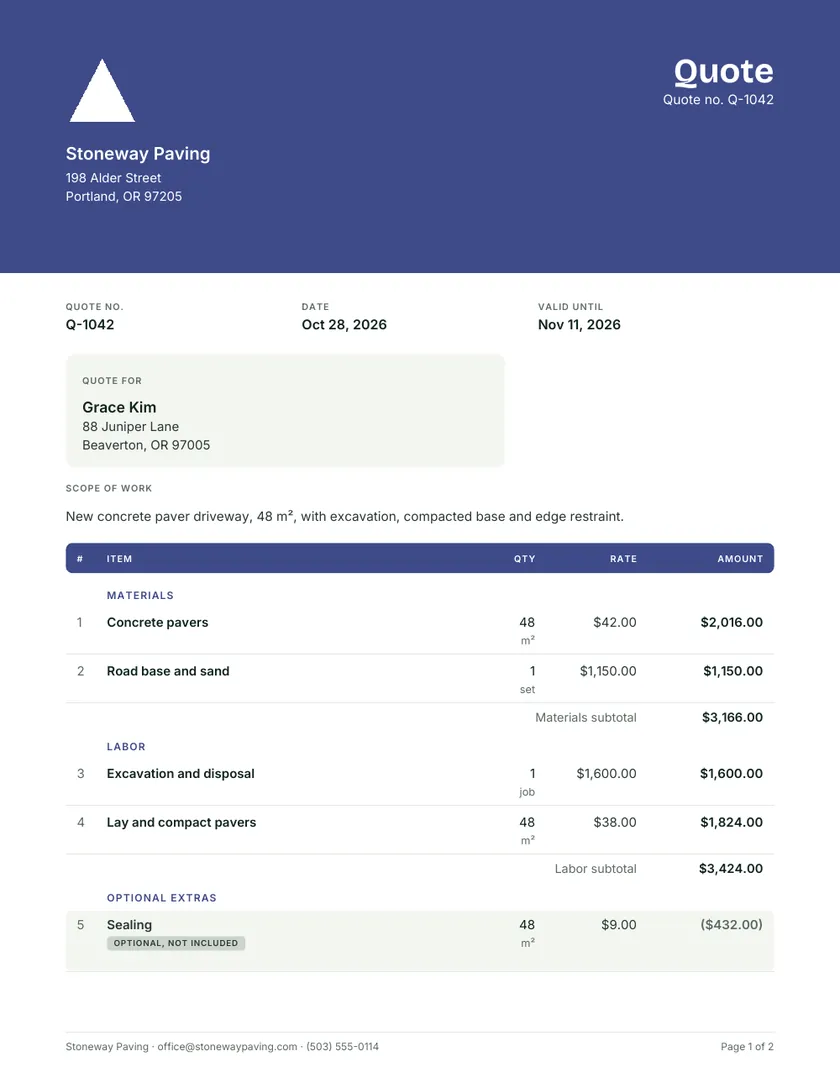
Sample paving quotation: 48 m² paver driveway
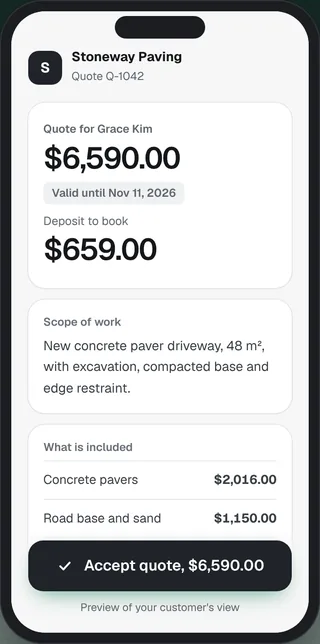
Stoneway Paving quotes Grace Kim for a new concrete paver driveway of 48 m². Materials are the pavers at $42 per m² and road base with sand as one $1,150 item. Labor covers excavation and disposal at a fixed $1,600, then laying and compacting at $38 per m². Sealing the finished surface is optional at $9 per m². The subtotal comes to $6,590 and a 10% deposit is set. The rates are for illustration only.
| Item | Group | Qty | Rate | Amount |
|---|---|---|---|---|
| Concrete pavers | Materials | 48 m² | $42.00 | $2,016.00 |
| Road base and sand | Materials | 1 set | $1,150.00 | $1,150.00 |
| Excavation and disposal | Labor | 1 job | $1,600.00 | $1,600.00 |
| Lay and compact pavers | Labor | 48 m² | $38.00 | $1,824.00 |
| Sealing | Optional extras (optional) | 48 m² | $9.00 | ($432.00) |
| Subtotal before tax | $6,590.00 | |||
| Optional extras, not in the total | $432.00 | |||
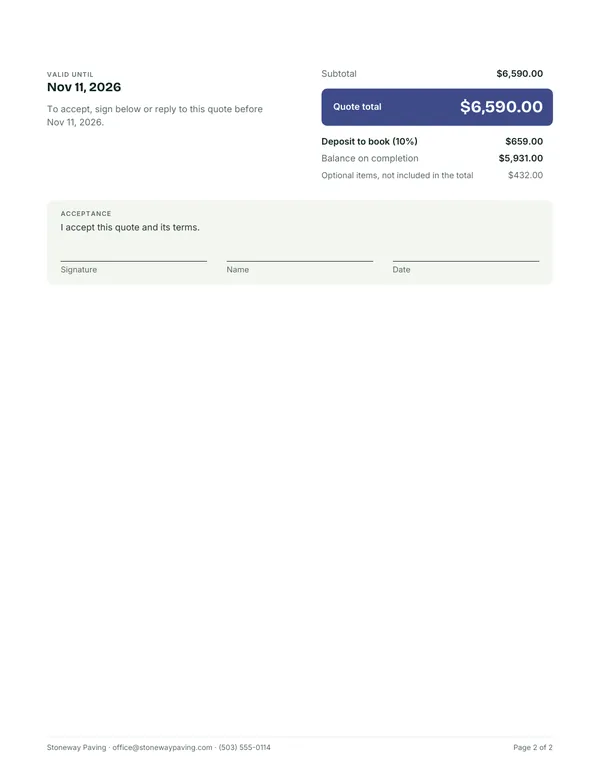

5 lines are filled in, from concrete pavers to sealing. Put in your own paving rates, then download the PDF.
How to price a paving job
Paving is usually priced per square meter or square foot laid, but excavation and base can swing the total more than the choice of paver. Price the dig and the base apart from the laying, so poor ground, a deep base or tight truck access shows honestly in the number.
- Laying rate per areaA rate per m² or ft² for screeding, laying, cutting and compacting, kept separate from the pavers, so the customer can change product without changing your labor.
- Excavation by volume or lump sumPrice the dig by cubic yards or m³ removed, or as one job when you know the machine time and the number of loads. Include tip fees.
- Base by volumeTons or m³ of road base and sand from your takeoff, plus delivery. Compaction means you order more loose material than the finished depth suggests.
- Extras eachDrains, steps, cuts around manholes and contrasting borders, priced each or per linear foot.
Machine hire and trucking are easy to underprice on small jobs, and a minimum charge per machine day protects you. See the guide to overhead costs for spreading yard and equipment costs across jobs.
Worked example: base and spoil for a 600 ft² driveway
The pavers are the visible part of the price. This example works out the hidden part for a 600 ft² driveway, using example supplier prices.
- Set the depthAllow 3 in for the paver, 1 in for bedding sand and 8 in of compacted base: a 12 in dig.
- Spoil volume600 ft² x 1 ft = 600 ft³, divided by 27 = 22.2 yd³ in the ground. Dug soil bulks up; at 25% swell that is about 27.8 yd³, or two 14 yd³ truckloads.
- Base rock8 in is 0.667 ft, so 600 x 0.667 = 400 ft³, or 14.8 yd³. Add 20% for compaction: 17.8 yd³ at an example $45 = $801.
- Bedding sand1 in over 600 ft² is 50 ft³, or 1.85 yd³. Order 2 yd³ at an example $50, which is $100.
- Haul away and totalTwo loads at an example $280 each for trucking and tipping is $560. Base, sand and haul away total $801 + $100 + $560 = $1,461 before pavers and labor.
Clay soil, a soft subgrade that needs geotextile fabric, or a deeper base for heavy vehicles all add depth, and every extra inch adds both base rock and spoil.
Paving inclusions and exclusions
Usually included
- Marking out and setting levels and falls
- Excavation and removal of spoil
- Compacted base and screeded bedding sand
- Edge restraint along open edges
- Jointing sand, final compaction and sweep up
Excluded unless priced
- Breaking out existing concrete or asphalt unless listed
- New drains or stormwater connections
- Soft subgrade repairs or geotextile
- Moving meters, valve boxes or utilities
- Curb cuts and permits for work on public land
- Sealing unless selected
Paving quote mistakes
- Quoting a driveway with a garden path base, then watching pavers rut under the first delivery truck.
- Forgetting swell when pricing spoil removal, and paying for the extra truckload yourself.
- Leaving edge restraint off the quote, so a cheaper price without it looks like the same job.
- Not checking falls, so rainwater runs toward the garage instead of the street.
- Assuming a truck can reach the work area when the only way in is over a lawn or down a narrow side path.
- Pricing old concrete removal from the surface without checking its thickness or reinforcement.
Paving and driveway quote questions
How do you price a paving job?
Measure the area, set the excavation depth for the loads the surface will carry, and work out spoil, base and sand volumes. Price the dig and disposal, base materials, pavers, edge restraint and laying separately, then add drains, cuts and sealing. The job pricing guide adds overhead and profit.
What should be included in a driveway quote?
The area and pattern, excavation depth, base material and thickness, bedding sand, paver product and thickness, edge restraint, drainage, jointing, compaction, cleanup and optional sealing. It should also state exclusions, such as breaking out old concrete and permits for the apron.
Do I need a permit for a new driveway?
Often yes for work that touches the public curb, sidewalk or street, and sometimes for changes to driveway size or drainage. Rules are set locally, so check with the city or county before quoting and say on the quote who applies.
How much deposit should a paving contractor ask for?
Enough to cover the paver and base order is a common approach. The sample sets 10%. Some states limit down payments on home improvement contracts, so check the rules where you work. Our deposit guide explains the options.
Is sealing pavers worth adding to a quote?
Offer it as an optional line rather than including it by default. Sealing can help resist oil stains and hold joint sand in place, but it needs reapplying every few years, so quote the area and product and let the customer decide.
Pavers or poured concrete: which should I quote?
Quote what the customer asked for, and offer the other as an alternative if it suits the site. Pavers can be lifted and relaid for repairs, while poured concrete is one surface with control joints. The concrete estimate template covers poured slabs, and more layouts sit in the template library.