Quote follow up email templates that turn silence into a yes
A quiet customer is often just busy. Follow up two or three working days after sending, again a week in with something useful, and once more before it expires.
- Three emails to copy, from first nudge to final reminder
- Phone and text scripts for when email goes unanswered
- What to say to too expensive and still deciding
By WhizQuote Editorial · 8 minute read
Send the first quote follow up email two or three working days after the quote, asking whether the customer has questions. Follow up again about a week after sending with something useful, such as an option or a date you can hold. Send a last note a few days before the quote expires, then close the file politely if there is no reply.
Why following up is part of quoting
Customers rarely say no to a quote outright. More often they mean to reply and do not, because they are comparing prices, waiting on a partner, or simply busy. A follow up gives them an easy moment to respond, answers the question holding them back, and shows how you will communicate once the job starts.
Following up is not pressure if each message is short, polite and useful. The aim is a decision, yes or no, not talking anyone into work they do not want. A clear no is worth more than weeks of silence, because it frees the dates you were holding.
How to follow up on a quote: a timing plan
Three touches after the quote goes out is enough for most jobs: a check after two or three working days, a useful follow up around a week, and a final note shortly before the price expires. Use the channel the customer prefers where you know it, and stop as soon as you have an answer.
| When | Channel | Purpose | Length |
|---|---|---|---|
| Day 0 | Email with the PDF | Send the quote and explain how to accept | A few short paragraphs |
| Day 2 or 3 (working days) | Check it arrived and invite questions | Three or four sentences | |
| Around day 7 | Phone call or text | Find the concern, offer an option | Under two minutes |
| 3 days before expiry | Give the date and what happens after it | Three sentences | |
| After expiry | Close the file and leave the door open | Two sentences |
For a 14 day quote sent on Tuesday 3 November, that means an email on 5 or 6 November, a call around 10 November, and a final reminder on 14 November, three days before it expires on 17 November. If you build quotes in the free quote maker, the quote shows an Expires soon flag in those last three days, a natural prompt for the final note.
Quote follow up template: the first email
The first follow up checks the quote arrived and invites questions. Keep it light and specific: name the job, the quote number and one detail from your visit. Do not repeat the whole quote or ask whether they have decided yet, which can feel like a push this early in their thinking.
Hi [Grace],
Just checking the quote for [repainting the hallway and two bedrooms] reached you on [Tuesday]. If anything in it is unclear, or you would like a line explained, reply here or call me on [phone].
Thanks,
[Your name], [Business name]
Send it as a reply to your original email, so the quote stays attached in the same thread and the customer does not have to search for it.
The second follow up: add something useful
A week in, a plain “any news” message adds nothing. Give the customer a reason to reply instead: answer a question they are probably asking themselves, offer a smaller option, or mention a start date you can hold. This is the message most likely to restart a stalled decision.
Hi [Grace],
Two things that might help with the [painting] quote. If you would like to spread the cost, I can [do the hallway now and the bedrooms in the new year], which makes the first stage [$1,150 plus tax]. I also have [Thursday 19 November] free and can hold it for you until [Friday].
Either way, happy to talk it through.
[Your name]
Only offer an option you would be glad to do at that price. If you would rather not split the work, share something else of value: a photo of a similar room you finished, or an answer to a common worry such as how long rooms will be out of use.
The final reminder before the quote expires
The last email tells the customer the quote is about to lapse and what happens next. It is honest information, not a sales trick, because material prices and your diary really do change. Give the date, say what will happen after it, and make accepting a one step reply.
Hi [Grace],
A quick note that your quote for [the hallway and bedrooms] is valid until [Tuesday 17 November]. After that I will need to recheck paint prices and my schedule before confirming. If you would like to go ahead, just reply yes and I will send the booking details.
[Your name]
Hi [Grace], I have not heard back, so I will close this quote for now. If you want to pick it up later, reply any time and I will update the price for you. Thanks for considering us.
[Your name]
Following up by phone or text
A call is often the fastest way to learn what is holding a customer back, because people say things on the phone they would not put in writing. Keep calls short and have the quote open in front of you. Texts suit quick checks with customers who already message you, but keep prices in writing by email too.
What to say to the replies you get
Every reply, even a vague one, tells you what to do next. Match your answer to what the customer is actually saying. Most replies fall into a few groups, and each has a better response than repeating your price or offering a discount straight away.
| They say | What it often means | Your next move |
|---|---|---|
| It’s more than we expected. | A budget gap, or the value is not clear | Ask which part concerns them, then offer a reduced scope rather than a lower rate |
| We need to think about it. | An open question, or a second opinion pending | Ask what would help them decide and when to check back |
| We’re getting other quotes. | Comparing | Offer to walk through your line items so they compare like with like |
| We went with someone else. | Lost | Thank them, ask one short question about why, and leave the door open |
| No reply after three touches | Not a priority, or a quiet no | Send the closing email and stop |
When the job is lost, the guide to responding to a rejected quote has reply scripts. When the answer is yes, confirm it in writing the same day; the quote acceptance guide has wording for that confirmation.
Keep track of every open quote
Follow ups only happen reliably when you can see which quotes are open. A simple list works: the quote number, customer, job, value, date sent, valid until date, next follow up date and status. Review it at the same time each week, and update it the moment a customer answers.
A spreadsheet or notebook is enough to start. If you would rather have software do the remembering, WhizInvoice sends and tracks quotes, turns an accepted one into an invoice in one click, and you can start free. For the first message in the sequence, use the quote email templates, and find related topics in our quoting guides.
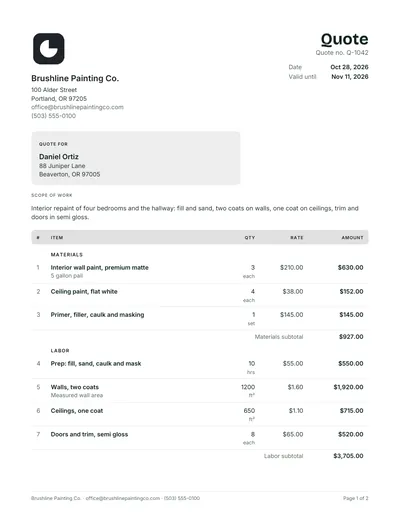
Choose 7, 14 or 30 days, and the quote flags Expires soon in its last three days.
Quote follow up questions
How long should I wait to follow up on a quote?
Two or three working days after sending is a good first follow up. That gives the customer time to read it without the job going cold. For urgent work, such as a repair, a call the next day is reasonable; for large projects with several decision makers, allow a little longer.
How many times should you follow up on a quote?
Three times after sending is a sensible limit for most jobs: an early check, a useful follow up around a week, and a final reminder before the quote expires. After that, send a short closing note and stop. More messages than that tend to irritate without changing the outcome.
What do you say when following up on a quote?
Name the job and quote number, check it arrived, and invite questions. In later messages, add something useful, such as an option, a date you can hold or an answer to a likely concern. Always finish with one easy next step, such as replying yes or calling you.
Is it pushy to follow up on a quote?
Not if the messages are short, spaced out and useful. Plenty of customers are glad of the reminder because they meant to reply. It becomes pushy with daily messages, invented deadlines or pressure to decide on the spot during a call.
Should I follow up by phone or email?
Use both. Email keeps a written record and suits the first check and the final reminder. A phone call works better around the one week mark, because it brings out concerns people do not put in writing. Follow the customer’s lead if they prefer texts.
What if the customer asks for a discount when I follow up?
Ask what part of the price concerns them first. A smaller scope, a cheaper material or splitting the work into stages often solves it without cutting your rate. If you do lower the price, change something in the scope so the new figure still covers your costs and profit.