Quote number format you will never mix up
Use a prefix, the year and a zero padded count, never reuse a number, and add R1 for revisions. Print it on every invoice so your paperwork lines up.
- Eight numbering formats, each with an example
- A five step setup and clear revision rules
- A simple log that links quotes, jobs and invoices
By WhizQuote Editorial · 8 minute read
A quote number is a unique reference on each quote, such as Q-2026-0042. Use a prefix, the year and a running count padded with zeros, never reuse a reference, and add a suffix like R1 for revisions. Print the quote reference on the deposit invoice and the final invoice so the paperwork links up.
What a quote number is for
A quote number is a unique reference given to one quote and never used again. It lets you find that quote in seconds when the customer calls, shows exactly which version they accepted, and ties the quote to the job, the deposit invoice and the final invoice that follow it.
- Matching a customer’s reply, such as “we accept Q-2026-0117”, to the exact version and price.
- Chasing open quotes before their valid until date passes.
- Carrying the reference onto invoices so each payment lands against the right job.
- Counting how many quotes you send and win each month.
- Finding last year’s price quickly when a similar job comes in.
The follow-up point matters more than it looks. A log sorted by reference and expiry shows which quotes to chase this week, and the guide on following up a quote has the wording.
Quote number format options, with examples
You can choose your own format, so pick one that suits how you work and how many quotes you send. The table shows eight patterns, each with an example, what it does well and what to watch. For a small business, a prefix, the year and a padded running number covers almost every need.
| Format | Example | Good for | Watch out for |
|---|---|---|---|
| Plain sequence | 1042 | Very low volume | Easy to confuse with an invoice; no year |
| Prefix and sequence | Q-1042 | Telling quotes from invoices at a glance | Grows long over the years |
| Year and sequence | Q-2026-0042 | A few quotes a week, restarting each January | Pad to four digits so it sorts |
| Year, month and sequence | Q-202610-007 | High volume with monthly reporting | Longer to read out on the phone |
| Job type code | Q-RF-26-0153 | Several services under one business name | Keep the code list short |
| Customer code | Q-OKA-003 | Repeat commercial customers | Breaks if the customer’s name changes |
| Branch or crew code | DEN-Q-0153 | More than one location or crew | Agree the codes before anyone uses them |
| Revision suffix | Q-2026-0042-R2 | Any system, for changed versions | Always keep the base reference |
Setting up a quotation number system in five steps
Set the system up once, write it down and use it on every quote from then on. Five decisions cover it: the prefix, whether the year goes in, how many digits, where the count starts and how revisions are marked. You can change format later, but it makes old records harder to search.
- Pick a prefixQ for quotes, E for estimates and INV for invoices, so one glance tells you what the document is.
- Decide whether to include the yearAdding it, as in Q-2026-, lets the count restart every January without two quotes ever sharing a reference.
- Pad the running numberFour digits (0001 to 9999) allow up to 9,999 quotes a year and keep spreadsheets sorting correctly, because 0042 sorts before 0153 while plain 42 can land after 153 when sorted as text.
- Choose where the count startsAny starting point works. 0001 is honest and simple, and there is no need to start high to look established.
- Fix the revision ruleA changed quote keeps its base reference and gains R1, R2 and so on, so every version traces back to the first.
Write the rule on one line where everyone who quotes can see it, for example: “Q, year, four digit count, R for revisions: Q-2026-0042-R1.”
Numbering revised quotes
When a customer asks for changes, issue a revised quote with the same base reference and a revision suffix, such as Q-2026-0042-R1, and mark the earlier version as superseded. The customer then refers to one clear document, and you never invoice from an out-of-date price.
| Version | Reference | What changed | Total | Status |
|---|---|---|---|---|
| Original | Q-2026-0042 | 16 × 20 ft deck, composite boards | $14,900.00 | Superseded |
| Revision 1 | Q-2026-0042-R1 | Switched to pressure-treated boards | $11,650.00 | Superseded |
| Revision 2 | Q-2026-0042-R2 | Added two steps and a gate | $12,480.00 | Accepted |
Print a line on each revision such as “This quote replaces Q-2026-0042-R1 dated October 14, 2026.” If the job changes after acceptance, that is a change order rather than a revision, so number it against the job, for example CO-0042-01. The guide to change orders and variations covers how to price them.
Connecting quotes, jobs and invoices
The reference should follow the work all the way to payment. Either reuse the base number for the job and its paperwork, or keep separate invoice numbers and print the quote reference on each invoice. Both work, as long as anyone can trace an invoice back to the accepted quote in one step.
| Document | Its own number | Reference printed on it |
|---|---|---|
| Accepted quote | Q-2026-0117-R1 | |
| Job folder | J-0117 | Q-2026-0117-R1 |
| Deposit invoice | INV-2026-0388 | Quote Q-2026-0117-R1 |
| Change order | CO-0117-01 | Job J-0117 |
| Final invoice | INV-2026-0412 | Quote Q-2026-0117-R1, deposit INV-2026-0388 |
Keep invoices in their own unbroken run, separate from quotes, and ask your accountant whether your tax authority sets rules for invoice numbers. The quote sequence is yours to design. The quote to invoice page shows how the details carry across once the customer says yes.
Keep a log next to the numbers
A numbering system works best with a simple log: one row per quote with the date sent, customer, total, valid until date and status. It takes a minute per quote and shows at a glance which ones need a follow-up, which have expired and how many you won this month.
| Reference | Sent | Customer | Total | Valid until | Status |
|---|---|---|---|---|---|
| Q-2026-0141 | Oct 6 | R. Okafor | $2,480.00 | Oct 20 | Accepted |
| Q-2026-0142 | Oct 7 | L. Brandt | $11,950.00 | Nov 6 | Revised |
| Q-2026-0142-R1 | Oct 14 | L. Brandt | $11,200.00 | Nov 13 | Accepted |
| Q-2026-0143 | Oct 9 | M. Silva | $640.00 | Oct 16 | Declined |
| Q-2026-0144 | Oct 13 | T. Nguyen | $5,315.00 | Oct 27 | Expired |
| Q-2026-0145 | Oct 20 | J. Park | $3,870.00 | Nov 3 | Sent |
Count each base reference once when you work out a win rate. If October shows 12 quotes sent, counting revisions with their original, and 5 accepted, the win rate is 5 ÷ 12 = 41.7%. Counting revisions as extra quotes would make it look worse than it is. If you quote from the Excel quote template, keep the log on its own sheet in the same workbook.
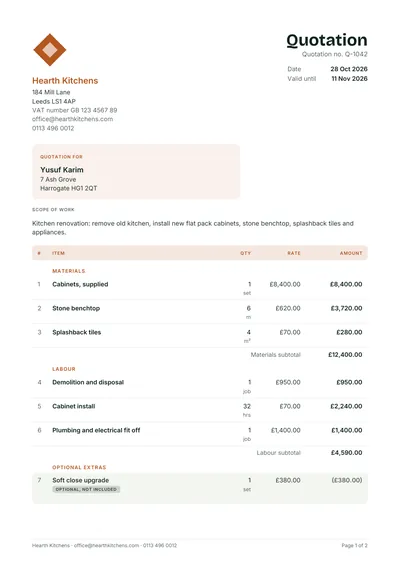
Type your reference in the Quote no. field, set a valid until date and download the PDF.
Numbering mistakes that cause confusion
Numbering problems stay small until a customer pays the wrong amount or disputes which version they accepted. These are the faults behind that confusion, and each one is easy to avoid once the format is written down and everyone who sends quotes follows it.
- Reusing a reference after a quote is declined or expires.
- Restarting at 001 every month without the month in the reference, so January and February both have a 001.
- Giving a revised quote a brand new reference, which breaks the link to the original.
- Relying on the customer’s name as the only reference.
- Two people numbering from separate lists. Use one shared log, or give each a crew code.
- Running quotes and invoices through one sequence, which leaves gaps in the invoice run.
Quote numbering questions
What is a quote number?
It is a unique reference printed on a quote, such as Q-2026-0042, used to identify that quote and no other. It appears near the date and valid until date, and it is repeated on the invoices for the job so every document links back to the accepted price.
What is a good quote number format?
A prefix, the year and a four digit running number suits a small business well: Q-2026-0001, Q-2026-0002 and so on. It tells quotes apart from invoices, restarts cleanly each year and sorts correctly in a spreadsheet. Add R1, R2 for revisions.
Should quote numbers be sequential?
It is the simplest way to guarantee each one is unique, and it makes gaps easy to spot in your log. Unlike invoices, a missing quote in the run causes no harm, but a duplicated one does, because two documents then share a reference.
Can quotes and invoices share the same number?
They can share the base, such as Q-0117 and INV-0117, if every quote becomes exactly one invoice. That breaks down with deposit invoices, stage payments and declined quotes, so a separate invoice sequence that prints the quote reference is usually cleaner.
What number should my first quote be?
Any number works. Starting at 0001, or at 0001 within the year, is simple and honest. There is no advantage in starting at 1000 to look bigger; customers judge you on the quote itself, not the reference.
Where does the quote number go on the quote?
Near the top, beside the date and the valid until date, where the customer can quote it back to you. In the free quote maker you type it into the Quote no. field, and it appears on the PDF next to the dates.