How to price a job without guessing the number
Price labor, materials, equipment, overhead and profit separately, then divide costs by one minus your target margin. Our 80 ft cedar fence costs $4,023.22 and quotes at $4,733.20.
- One fence priced from tape measure to total
- A labor cost table and materials list to reuse
- The margin math that turns cost into price
By WhizQuote Editorial · 9 minute read
To price a job, work out five things separately: labor (hours times your cost per hour), materials at current prices, equipment and disposal, a share of overhead, and profit. Add the costs, then divide by 1 minus your target margin. Our 80 ft fence example costs $4,023.22 and is priced at $4,733.20 for a 15% margin.
The five parts of every job price
A job price is made of five parts: labor, materials, equipment and outside costs, overhead, and profit. The first four are costs you can measure or look up. Profit is a decision, and it goes on last, as a margin on the selling price, so nothing you add later quietly eats into it.
- Labor: hours per task multiplied by what each worker costs you per billable hour, not their wage.
- Materials: quantities from your measurements at current supplier prices, plus waste on anything you cut.
- Equipment and outside costs: rentals, dump fees, permits and subcontractors, at what you pay.
- Overhead: a share of rent, vehicles, software and admin, charged per hour of work.
- Profit: the margin that pays you for the risk and lets the business grow.
The rest of this guide prices one real job through all five parts: 80 linear ft of 6 ft cedar privacy fence on level, clear ground.
Measure the job and turn it into quantities
Pricing starts with a takeoff: measuring the site and turning it into quantities and tasks. For the fence, posts every 8 ft along 80 ft gives 10 bays and 11 posts. Three rails per bay and tight butted pickets give the rest. Write every quantity down, because each one becomes a line on the quote.
- Posts: 80 ÷ 8 = 10 bays, plus one end post = 11.
- Rails: 10 bays × 3 = 30.
- Pickets: 960 in of fence ÷ 5.5 in per picket = 174.5, so 175, plus 5% for splits and offcuts = 184.
- Concrete: 2 bags per post × 11 = 22 bags.
- Post caps: 11.
Note the site conditions that change the hours as well: slope, roots, rock, access for a post hole auger, utility lines to be marked before digging, and where the spoil goes. Those notes turn into exclusions on the quote later.
Labour cost calculator: the worked table
This table works as a labour cost calculator for any job. First turn each wage into a cost per billable hour, then multiply by the hours each task takes. The lead earns $30.00 and the helper $21.00 an hour; the burden and billable share are example figures to replace with your own.
| Rate build up | Lead | Helper |
|---|---|---|
| Hourly wage | $30.00 | $21.00 |
| Plus labor burden (example 25%) | $7.50 | $5.25 |
| Loaded cost per paid hour | $37.50 | $26.25 |
| Divide by billable share (example 80%) | ÷ 0.80 | ÷ 0.80 |
| Cost per billable hour | $46.88 | $32.81 |
| Task | Lead hrs | Helper hrs | Labor cost |
|---|---|---|---|
| Set out and dig 11 post holes | 5 | 5 | $398.45 |
| Set posts in concrete | 3 | 3 | $239.07 |
| Fit rails and pickets | 8 | 8 | $637.52 |
| Post caps, final check and clean up | 2 | 2 | $159.38 |
| Total | 18 | 18 | $1,434.42 |
Each row is lead hours × $46.88 plus helper hours × $32.81. The first row, for example, is $234.40 + $164.05 = $398.45. The full method behind burden and billable share is in how to calculate labor cost.
Price materials at today’s supplier prices
Price materials from the takeoff quantities and this week’s supplier prices, not a figure from last season. Ask for a written price on larger orders, include waste on cut items and add any delivery charge. In this example the fence materials come to $1,769.80 before any markup.
| Item | Qty | Unit price | Cost |
|---|---|---|---|
| 4 × 4 posts, 10 ft | 11 | $28.00 | $308.00 |
| 2 × 4 cedar rails, 8 ft | 30 | $14.00 | $420.00 |
| Cedar pickets, 5.5 in × 6 ft | 184 | $4.20 | $772.80 |
| Concrete mix, 50 lb bag | 22 | $6.50 | $143.00 |
| Post caps | 11 | $6.00 | $66.00 |
| Screws and nails | 1 lot | $60.00 | $60.00 |
| Materials total | $1,769.80 |
You can add a separate markup on materials to cover ordering, collection and returns, or let the overall margin carry it. This example uses the margin only so the math stays easy to follow; the materials markup guide shows the other approach.
Add equipment, disposal and overhead
Equipment and disposal are costs this job causes directly, so they go in at exactly what you pay. Overhead is different. Rent, vehicles, software and admin keep the whole business running, so each job carries a slice of them, sized by the crew hours it uses.
- Post hole auger rental, 1 day
- $95.00
- Dump fee for spoil and offcuts
- $40.00
- Overhead, 36 crew hrs × $19.00
- $684.00
The $19.00 rate is a year of overhead divided by a year of billable hours, and this overhead guide builds one from scratch. Charging overhead by the hour means a long job carries more of it than a quick one, which is fair: it ties up your crew and truck for longer.
Add profit and set the final price
Total the costs, then add profit as a margin on the selling price rather than a percentage of cost. The fence costs $4,023.22 in all. For a 15% margin, divide by 0.85. That gives a price of $4,733.20 before tax and leaves $709.98 of profit.
| Part of the price | Amount |
|---|---|
| Labor, from the table | $1,434.42 |
| Materials | $1,769.80 |
| Equipment and disposal | $135.00 |
| Overhead (36 hrs × $19.00) | $684.00 |
| Total cost | $4,023.22 |
| Price at a 15% margin ($4,023.22 ÷ 0.85) | $4,733.20 |
| Profit ($4,733.20 minus $4,023.22) | $709.98 |
Had you multiplied the cost by 1.15 instead, the price would be $4,626.70 and the profit $106.50 lower. The markup calculator converts between markup and margin if you prefer to think in one and quote in the other.
Then sense check it from the outside. $4,733.20 over 80 ft is $59.17 per linear ft. Compare that with your own past fence jobs and with what customers in your area accept. If it is far out, question your hours before you cut your margin.
How to quote for a job once the price is set
A price only earns money once it sits on a quote the customer can accept. Decide whether it is a fixed price or an estimate, lay the work out in groups, set a valid until date and a deposit, and state what is excluded. Then send it while your site visit is still fresh in the customer’s mind.
- Fixed price or estimate. A fence on level, clear ground suits a fixed price. Ground you cannot see into suits an estimate or a rock clause. See fixed price vs time and materials.
- Group the lines. Materials and Labor as separate groups, with units such as each and hrs. Offer staining as an optional extra the customer can tick.
- Valid until. 14 days is sensible when lumber prices are moving.
- Deposit. 30% of $4,733.20 is $1,419.96, enough to order the materials, with $3,313.24 due on completion. The guide to deposits on quotes covers how to size it.
- Exclusions. Removing an old fence, permits, boundary surveys and anything found below ground.
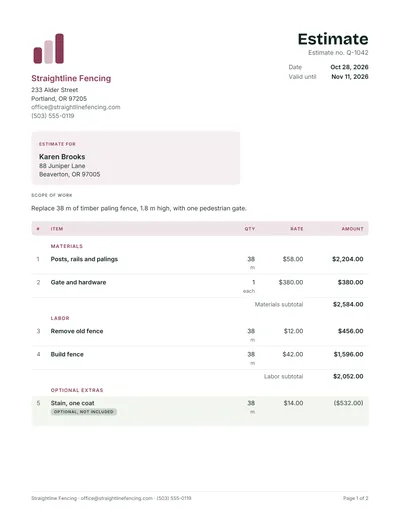
Group Labor and Materials lines, set units like hrs or each, add staining as an optional item and a deposit to book.
Pricing mistakes that lose the job or the profit
Underpriced and overpriced jobs usually trace back to the same handful of habits. Check every new price against this list, and take extra care on work you have not done before, where a guess at the hours does the most damage to the final number.
- Copying a competitor’s price without knowing what their costs are.
- Leaving out travel, setup, clean up and the run to the supplier.
- Using the wage instead of the labor cost per billable hour.
- Adding 15% to cost and believing it is a 15% margin.
- Forgetting rentals, dump fees and permit costs.
- Never comparing quoted hours with actual hours once the job is done.
The last one fixes the others over time. Keep a note of quoted and actual hours for each type of job, and your next price for that work will be closer. For the full layout of the finished document, see how to write a quote.
Job pricing questions
How do I work out how much to charge for a job?
Add up the job’s labor cost, materials, equipment and its share of overhead, then divide the total by 1 minus the margin you want. For a 20% margin, divide by 0.80. Check the result per unit, such as per linear ft or per room, against your past jobs before you send it.
What profit margin should I use on a job?
We do not quote an industry figure, because the right margin depends on your trade, your overhead and the risk in the job. Start from what you need: enough to pay for slow months, warranty callbacks and growth. Raise it on jobs with unknowns, tight deadlines or difficult access.
Should I price by the hour or by the job?
Price by the job when the scope is clear and you can measure it, because customers prefer a fixed number. Price by the hour, as time and materials, when you cannot see the full extent of the work, such as repairs behind walls. Many quotes mix both, with a fixed price and an hourly rate for extras.
How do I price a job I have never done before?
Break it into tasks you have done, estimate each one, and add time for learning. Ask suppliers for prices and lead times. Add a contingency for the unknown parts, or quote those parts at an hourly rate. Record the actual hours afterwards so the next one is priced on facts.
Do I include sales tax or GST in the job price?
Work out the price before tax, then add the tax your location requires on the quote, such as sales tax, GST or VAT, and say clearly whether totals include it. The free quote maker has tax presets for ten countries and can show prices with tax added or included.