Quotation format in India ready for GST and GSTIN
Indian buyers expect your GSTIN, HSN or SAC codes and GST shown clearly. This layout has them in INR, plus when an accepted quotation binds you under the Contract Act.
- GSTIN, HSN or SAC codes and INR fields included
- How long your offer stays open, and GST on advances
- Free to download in Excel, Word or PDF
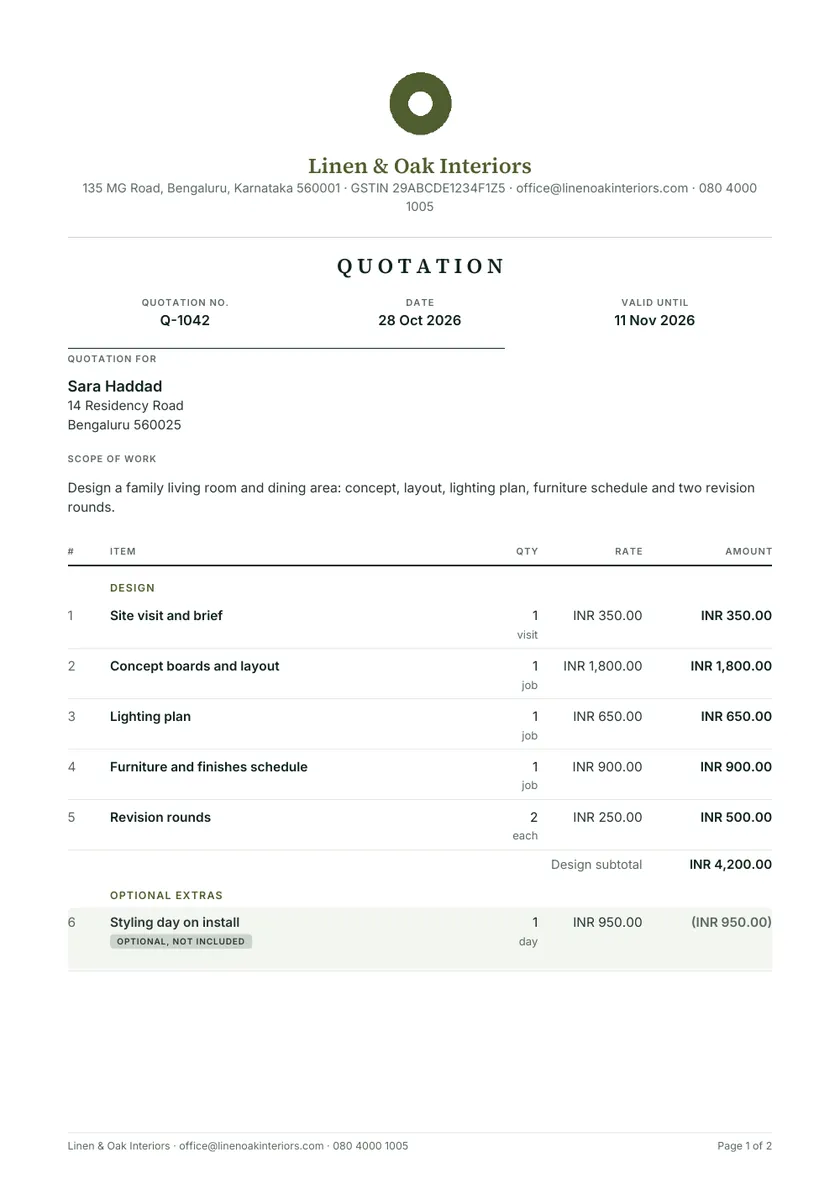
A quotation in India works as a proposal under the Indian Contract Act. When the buyer’s acceptance is absolute and unqualified it becomes a promise, and an agreement enforceable by law is a contract. If you state a validity period, the offer lapses when it ends. A GST quotation should show your GSTIN, HSN or SAC codes, the taxable value and CGST plus SGST, or IGST, separately.
Quotations in India at a glance
This quotation format for India is set up with GST, your GSTIN, HSN or SAC codes and INR, and it follows the official rules: how the Indian Contract Act treats a quotation once it is accepted, how long an offer stays open, the GST registration limits, GST on advances, and the consumer law that applies to services. Download it free in Excel, Word or PDF.
- Usual title
- Quotation, or Estimate when the price may change
- GST structure
- Standard 18%, merit 5%, special 40% (services from 22 September 2025)
- Register for GST
- Above Rs 20 lakh for services, Rs 40 lakh for goods only (lower in some States)
- Business ID
- 15 digit GSTIN, with your PAN inside it
- Paper and dates
- A4, 28/10/2026
- Spelling
- British: labour, colour
Is a quotation legally binding in India?
A quotation binds you once the buyer accepts it on its terms. The Indian Contract Act, 1872 says a person who signifies willingness to do something, to obtain another’s assent, makes a proposal. When the other person signifies assent, the proposal is accepted and becomes a promise, and an agreement enforceable by law is a contract.
Three more sections decide most quotation disputes:
- Section 7. Acceptance must be absolute and unqualified. A purchase order that changes your price, quantity or delivery terms does not accept your quotation as it stands, so confirm in writing which terms apply before you start.
- Section 8. Performing the conditions of a proposal, or accepting consideration offered with it, is an acceptance. If your quotation says that paying the advance confirms the order, the payment itself can be the acceptance.
- Section 5. A proposal may be revoked at any time before the communication of its acceptance is complete as against the proposer, but not afterwards. Withdraw an outdated quotation in writing, and promptly.
Section 10 adds that agreements are contracts when made by the free consent of parties competent to contract, for a lawful consideration and with a lawful object. Our guide on whether a quote is legally binding covers the general principles.
How long is a quotation valid in India?
For as long as you say, or for a reasonable time if you say nothing. Section 6 of the Indian Contract Act says a proposal is revoked by the lapse of the time prescribed in it for acceptance or, if no time is prescribed, by the lapse of a reasonable time without communication of the acceptance.
What counts as reasonable is argued after the event, which is exactly the argument to avoid when steel, cement or copper prices move. Print a validity date on every quotation: 15 or 30 days suits most trades and interior work, and 7 days suits items with volatile prices. Section 6 also ends a proposal when the acceptor fails to fulfil a condition precedent to acceptance, so stating a condition, such as receipt of the advance by a set date, gives the quotation a clear end point. The guide to quote validity has wording you can copy.
GST quotation format: the fields to include
A GST quotation format should carry the same details your tax invoice will, so the invoice can be raised straight from the accepted quotation. The fields below follow the particulars GST rules set for a tax invoice, adapted for a quotation. Title the document Quotation, not Tax Invoice.
| Field | What to write |
|---|---|
| Supplier | Name, address and GSTIN |
| Quotation number and date | A serial number unique within the financial year, and the date of issue |
| Buyer | Name, address, and GSTIN if registered |
| Place of supply | Name of the State and its code, which decides CGST and SGST or IGST |
| Line items | Description, HSN code for goods or SAC for services, quantity, unit and rate |
| Taxable value | Value of each line after any discount |
| GST | Rate and amount of CGST and SGST, or of IGST, shown separately |
| Total | In figures and words, in INR |
| Terms | Valid until date, advance, payment stages, completion time, exclusions |
| Signature | Signature or digital signature of the supplier or an authorised person |
For HSN digits, follow the tax invoice rule that has applied since 1 April 2021: a business with aggregate turnover up to Rs 5 crore in the preceding financial year shows 4 digits, and one above Rs 5 crore shows 6. The smaller business may leave the code off invoices to unregistered buyers, but showing it on a quotation helps the buyer check your rate.
GST rates on a quotation format with GST
The rate on your quotation depends on what you supply, so look up the HSN or SAC entry before you price. Following the 56th GST Council meeting, GST has a standard rate of 18%, a merit rate of 5% and a special rate of 40% for a select few goods and services, with the new rates on services applying from 22 September 2025.
The CBIC describes GST as levied concurrently by the Centre as CGST and by the States as SGST, with IGST levied by the Centre on inter-State supplies. On the quotation, show CGST plus SGST for a buyer in your own State and IGST for a buyer in another State. If you are not registered, leave GST off: without registration a person cannot collect tax from customers.
Our quotation format in Excel with GST has the formulas in place, so line totals, tax and the advance update as you type. Open the Excel quotation template, read the quotation format guide for layout, or use the formal quotation maker online.
GSTIN and the GST registration limits
Print your GSTIN at the top of every quotation once you are registered. It is a 15 digit number: the first 2 digits are the State code, the next 10 are the PAN of the legal entity, the next 2 are the entity code and the last is a check sum. Registration is PAN based and State specific, so a business with branches in several States holds one GSTIN per State.
Registration is mandatory once aggregate turnover in a financial year passes these limits:
- Services, or goods and services together: Rs 20 lakh, or Rs 10 lakh in Manipur, Mizoram, Nagaland and Tripura.
- Goods only, supplied within the State: Rs 40 lakh, or Rs 20 lakh in Arunachal Pradesh, Manipur, Meghalaya, Mizoram, Nagaland, Puducherry, Sikkim, Telangana, Tripura and Uttarakhand.
- Inter-State suppliers: registration is compulsory whatever the turnover, except that suppliers of taxable services with aggregate turnover within the Rs 20 lakh limit (Rs 10 lakh in the four States above) are exempt.
Below the limits you can still opt to register voluntarily. Registration is what lets you collect tax from customers and claim input tax credit on the tax you pay on your own purchases.
Advance payments against an accepted quotation
Asking for an advance on acceptance is normal, and GST law has a document for it. Whenever a registered person receives an advance for a supply, they must issue a receipt voucher. If no supply follows and no tax invoice is issued, a refund voucher can be issued against that payment.
- GST is payable on receipt of an advance for services only, not for goods.
- The receipt voucher shows your name, address and GSTIN, a serial number, the date, the buyer’s details, a description, the amount of the advance, the rate and amount of tax, the place of supply for inter-State supplies, and a signature.
- If the rate of tax cannot be determined when the advance arrives, tax may be paid at 18%.
Write the advance and stages on the quotation, for example 30% on acceptance, 40% when work reaches site and 30% on handover, so each receipt voucher and the final invoice line up. The guide to deposits on quotes compares common splits.
The Consumer Protection Act, 2019 and service quotations
When your customer is a consumer, the Consumer Protection Act, 2019 covers the service you quote. It defines deficiency as any fault, imperfection, shortcoming or inadequacy in the quality, nature and manner of performance undertaken under a contract, including the deliberate withholding of relevant information from the consumer.
Several of the Act’s listed unfair trade practices bear directly on quotations:
- Falsely representing that services are of a particular standard, quality or grade.
- Materially misleading the public about the price at which goods or services are ordinarily sold or provided.
- Not issuing a bill, cash memo or receipt for goods sold or services rendered.
- Refusing to withdraw deficient services and refund the consideration within the period stated in the bill or cash memo, or within thirty days if none is stated.
So describe materials by brand and grade, list exclusions plainly, and keep the accepted quotation with the final bill. For a trade example, see the interior design quotation template.
Sources
General information, not legal advice.
- Tripura High Court, Government of India text: The Indian Contract Act, 1872
- GST Council: Registration under GST law
- GST Council: Tax invoice and other such instruments in GST
- CBIC: Notification No. 78/2020, Central Tax (HSN digits on tax invoices)
- CBIC: GST, an update as on 1 June 2019
- PIB, Ministry of Finance: Recommendations of the 56th meeting of the GST Council
- PIB, Ministry of MSME: Development of the MSME sector (GST registration limits)
- Gazette of India text, Government of Goa: The Consumer Protection Act, 2019
Indian quotation questions
Short answers based on the official sources listed on this page. General information, not legal advice.
What is the correct quotation format in India?
Mirror your tax invoice. GST rules list what a tax invoice must show, so a quotation with the same fields converts cleanly: your name, address and GSTIN, a quotation number and date, the buyer’s details and GSTIN, place of supply, line items with HSN or SAC, quantity and rate, taxable value, CGST and SGST or IGST, total, validity and signature.
Is GST charged on a quotation?
GST is charged on the supply, not on the quotation itself, but a registered business should show the rate and amount so the buyer sees the full cost before accepting. Show CGST plus SGST for a buyer in your own State and IGST for a buyer in another State. If you are not registered, do not add GST.
Is an accepted quotation a contract in India?
Usually, yes. Under the Indian Contract Act a proposal becomes a promise when accepted, and an agreement enforceable by law is a contract. Acceptance must be absolute and unqualified, and paying an advance that the quotation asks for can itself be acceptance. Keep the signed copy or the written confirmation.
How long is a quotation valid?
For the time you state. Section 6 of the Indian Contract Act says a proposal lapses when the time prescribed for acceptance passes, or after a reasonable time if none is given. Writing “valid for 30 days from the date above” removes the argument about what is reasonable.
Do I need HSN or SAC codes on a quotation?
The legal requirement sits on the tax invoice: 4 digits of HSN for aggregate turnover up to Rs 5 crore and 6 digits above, with smaller businesses allowed to omit it on invoices to unregistered buyers. Showing the same code on the quotation lets the buyer check the GST rate before accepting.
What turnover requires GST registration?
Rs 20 lakh for suppliers of services, or Rs 10 lakh in Manipur, Mizoram, Nagaland and Tripura. For suppliers of goods only within a State, the limit is Rs 40 lakh, or Rs 20 lakh in several States including Telangana and Uttarakhand. You can register voluntarily below these limits.