Bid vs quote vs proposal and which one to send
A bid competes on set plans, a quote fixes a price for defined work, a proposal sells your approach and an estimate forecasts. One painting job shows all four.
- All four documents compared in a single table
- One painting job written as bid, quote, proposal and estimate
- What tender, RFQ and RFP are really asking you for
By WhizQuote Editorial · 7 minute read
A bid is a price submitted to compete for a job, usually in response to an invitation with fixed plans, rules and a deadline. A quote is a firm price for clearly defined work, offered directly. A proposal explains how you would solve the customer’s problem, with options and a price. An estimate is an approximate cost that can change.
Four documents, four different jobs
All four documents put a number in front of a buyer, but they answer different questions. A bid answers “what is your price for exactly this?” in a contest. A quote answers “what will this cost?” for one customer. A proposal answers “how would you solve this, and for how much?” An estimate answers “roughly what should I budget?”
- A bid is a formal price submitted in response to an invitation, against documents the buyer wrote, in competition with other bidders.
- A quote is a fixed price for work you have defined, valid for a stated period. Once accepted it is usually a contract.
- A proposal is a persuasive document setting out your understanding of the need, your approach, options, timeline and price.
- An estimate is an informed approximation, often a range, given when the scope or conditions are not yet certain.
Bid vs quote vs estimate vs proposal compared
The quickest way to see the differences is to compare who starts the process, who defines the scope and how firm the price is. A bid and a quote are both firm prices; the difference is that the buyer writes the scope for a bid, while you usually write it for a quote. Proposals and estimates leave more room to move.
| Feature | Bid | Quote | Proposal | Estimate |
|---|---|---|---|---|
| Who starts it | Buyer’s invitation | Customer’s request | Customer’s problem or brief | Customer’s early question |
| Scope written by | Buyer | You | You, often with options | You, loosely |
| Price | Firm, on the buyer’s form | Firm | Firm per option, or a range | Approximate or a range |
| Competition | Formal, side by side | Informal | Often judged on more than price | Rarely the deciding document |
| Typical length | Forms plus attachments | One to two pages | Several pages | One page |
| Binding once accepted | Usually | Usually | Usually, for the option chosen | Not as to the exact price |
| Common in | Commercial and public work | Trades and services | Design, IT, consulting, larger projects | Early planning, repairs with unknowns |
When you are writing a bid
If the buyer sent drawings, a specification, a bid form and a deadline, you are bidding. The buyer wants to compare like with like, so the rule is to follow their instructions exactly: price the scope they describe, on their form, in their format, by their deadline. A brilliant alternative that ignores the form can be set aside without being read.
- Read the whole package, including addenda issued after the invitation. They often change quantities or dates.
- Ask questions in writing before the question deadline, so answers go to every bidder.
- Price the base scope first, then any alternates the buyer asked for as separate lines.
- List your assumptions and exclusions where the form allows, briefly and specifically.
- Submit early. Late bids are often refused outright.
Public sector bids usually follow published procurement rules on format, deadlines and evaluation. Read them before you start. To ask suppliers for prices yourself, use the request for quotation template.
Quote vs proposal: let the scope decide
Send a quote when the customer knows what they want and needs a price for it. Send a proposal when they know the problem but not the solution, and your ideas are part of what they are buying. A quote for “paint four rooms in warm white, two coats” is enough; a brief to “refresh the office so it feels less dated” calls for a proposal.
A quote usually contains
- Scope of work in a few sentences
- Line items with quantities and rates
- Tax, total and deposit
- Valid until date
- Exclusions, terms, acceptance
A proposal adds
- Your understanding of the need
- The approach and why it fits
- Two or three options with prices
- Timeline and milestones
- Relevant past work and the team
A proposal still needs a clear price and acceptance terms; the quote proposal template combines both. Many trades keep it short: one page of approach, then the quote.
Where an estimate fits
An estimate is the right answer when the customer needs a number to plan with, but you cannot fix a price yet: the walls are not open, the design is not chosen, or the job depends on what you find. Give a range, name what drives it, and offer a firm quote once the unknowns are settled.
Estimates often come first and lead to a quote or a proposal later. The guide to writing an estimate shows the wording, the quote vs estimate comparison covers how binding each one is, and the estimate maker lets you set a low to high range on the page.
One painting job written four ways
A property manager wants 6,400 ft² of interior walls repainted in an office. The same job can arrive as any of the four documents, depending on how the manager asks and how much is known. The numbers below use $1.60 per ft² for walls, two coats, as an example rate.
| Document | How the price appears | Figure |
|---|---|---|
| Estimate | Walk-through only, wall condition unknown | $9,000 to $11,500 |
| Quote | 6,400 ft² × $1.60, two coats, valid 30 days | $10,240 |
| Bid | Base bid on the manager’s form, as specified | $10,240 |
| Bid alternate 1 | Weekend work so the office stays open | +$1,350 |
| Proposal option B | Low-odor premium paint, 6,400 ft² × $0.18 extra | +$1,152 |
Notice that the quote and the base bid carry the same figure. What differs is who wrote the scope and how the buyer will compare it. The proposal turns the same work into a choice, and choices often win work that a single price would not.
Tender, RFQ, RFP and other names you will see
Buyers use many labels for these documents, and the words change between countries and industries. Tender is common in British, Irish, Australian and New Zealand English for what Americans call a bid. Requests come with abbreviations too, and each one hints at the document the buyer expects back from you.
- RFQ
- Request for quotation. The buyer knows what they want and asks for a price. Reply with a quote.
- ITB or IFB
- Invitation to bid. A formal process with set documents. Reply with a bid on their form.
- RFP
- Request for proposal. The buyer describes a need and wants your approach. Reply with a proposal.
- Tender
- Another word for a bid, used widely outside North America.
- RFI
- Request for information. The buyer is gathering facts about suppliers or methods, usually before asking for any price.
Which document to send
Work out which document the buyer actually needs before you write anything. The answer usually sits in how they asked: forms and a deadline point to a bid, a clear list of work points to a quote, a problem with no fixed solution points to a proposal, and a budget question points to an estimate. When unsure, ask them.
- Did the buyer send their own forms, drawings and a deadline? Bid.
- Is the work defined well enough to price every line? Quote.
- Do they need your ideas or options to decide? Proposal.
- Are there unknowns you cannot price yet? Estimate, then a quote later.
For the quote itself, the step by step guide to writing a quote covers each part, and the free quote maker lays it out for you.
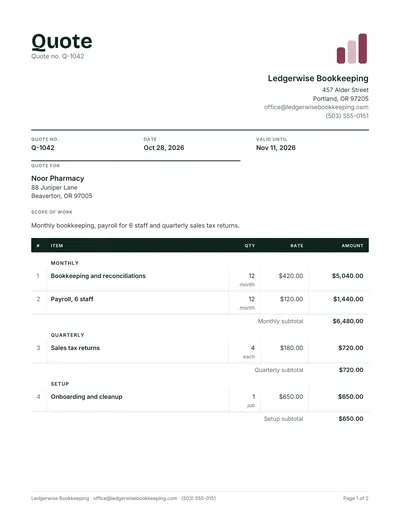
Line items, optional extras, tax and a valid until date on a clean PDF.
Bid, quote and proposal questions
Is a bid the same as a quote?
Both are firm prices, but a bid is submitted in a competitive process against documents the buyer prepared, often with strict rules and deadlines. A quote is usually offered directly to one customer for work you have described yourself. In everyday speech many people use the words loosely.
Is a bid legally binding?
A bid is an offer, so once the buyer accepts it a contract usually forms on the bid terms. Formal bidding processes can add their own rules, such as when a bid may be withdrawn. Read the invitation carefully, and see is a quote legally binding for the general principles.
What is the difference between a quote and a proposal?
A quote prices work that is already defined. A proposal also explains how you would approach a problem, often with options, a timeline and evidence of past work. Proposals suit design, IT and larger projects; quotes suit most trade and service jobs.
Should a proposal include a price?
Yes, unless the buyer asked for a first round without prices. A proposal without a price cannot be accepted, so it usually ends in a second request. Give a price for each option and the same acceptance and validity terms you would put on a quote.
What does base bid mean?
The base bid is your price for the scope exactly as specified. Alternates are separate prices for variations the buyer asked about, such as a different material or weekend work, which they can add or leave out when they award the contract.