Rate card template clear at a glance
Clients ask what you charge before they ask for a quote. Set out hourly and day rates, fixed price deliverables and monthly retainers, each with its terms.
- A filled rate card for a small marketing agency
- How to work out rates that pay
- Turn lines into a quote online, free
What a rate card is
A rate card template sets out what you charge for standard work: hourly and day rates, fixed price deliverables and monthly retainers, with the terms behind each. This page explains what a service rate card should include, how to calculate rates that pay, a filled marketing agency example, and how to turn rate card lines into a quote the client can accept.
A rate card is a short document listing the standard rates a freelancer, agency or service business charges, by the hour, day, deliverable or month, along with the conditions behind them. Clients use it to budget and compare. You use it to keep pricing consistent and answer early price questions without writing a full quote.
| Document | Prices | Typical user | Sent when |
|---|---|---|---|
| Rate card | Time and standard deliverables | Freelancers, agencies, consultants, media sellers | Early, before the work is scoped |
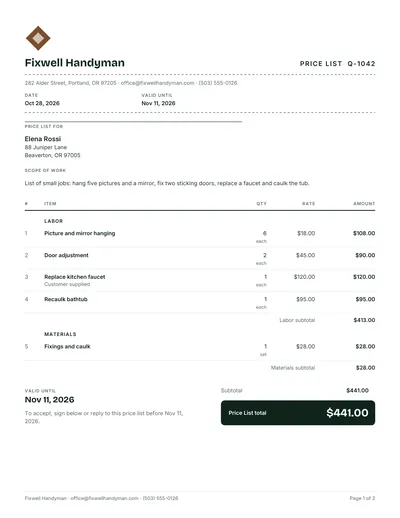
| Price list | Fixed tasks or products | Trades, cleaning, repair, retail | Any time, often published |
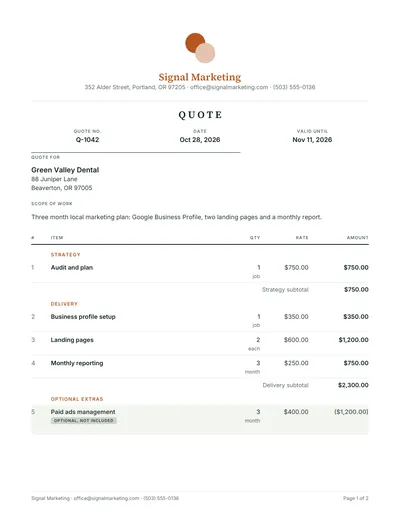
| Quote | One specific job, itemized | Every business | After scoping, for acceptance |
If most of what you sell is fixed tasks rather than time, a price list template fits better. Both sit alongside the main quote template library.
What to include on a service rate card
A service rate card should let a client price a small project on their own. Each rate needs a unit, a plain description of what one unit buys and any limits. Add the commercial terms that apply across the card, so nobody is surprised when the first quote arrives with a deposit or a rush charge.
On every line
- The rate type: hourly, half day, day, per deliverable or monthly
- What one unit includes, such as two revision rounds
- Minimums, such as a half day booking or a three month retainer
- What is billed on top, such as stock images or ad spend
Across the card
- Effective date and currency
- Whether rates include tax
- Deposit for projects, billing timing for retainers
- Rush and out of hours charges
- How extra revisions and changes are charged
Rate card example: a small marketing agency
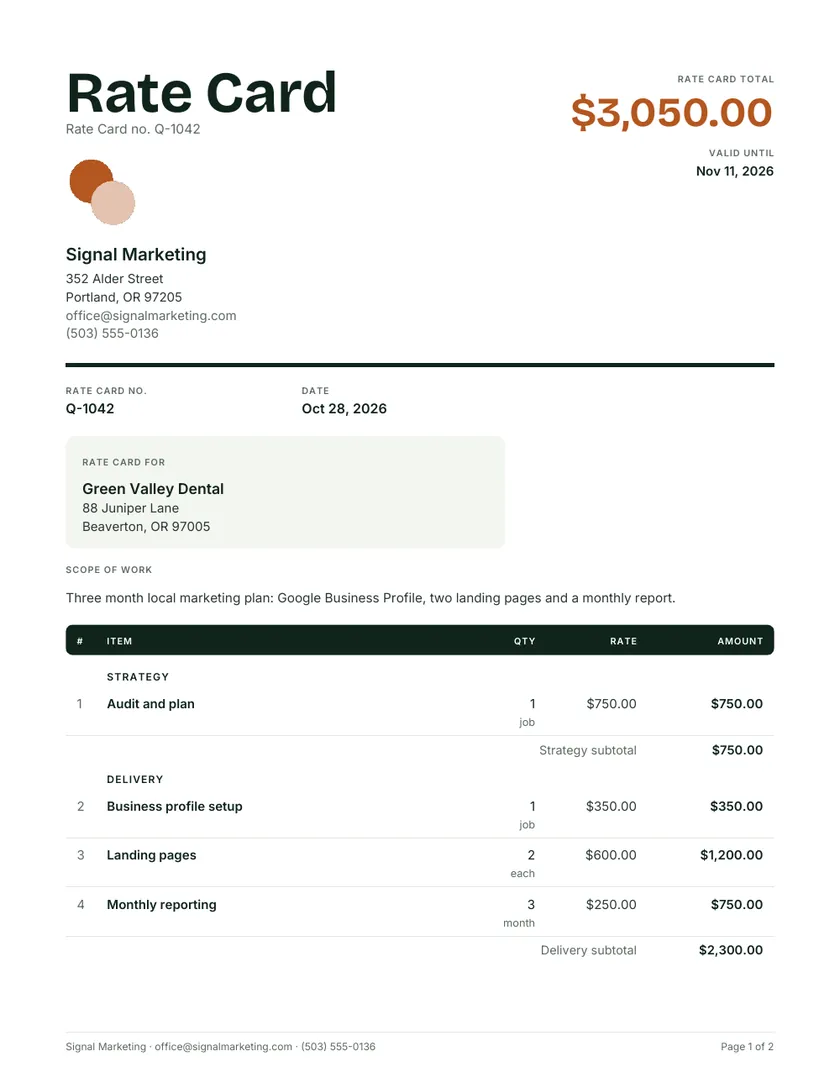
This example extends the marketing sample in the quote maker into a full rate card. The figures are invented for layout, but they hang together: the day rate is eight hours at the hourly rate less a small discount, and the retainer is priced from the hours and reporting it contains.
| Service | Unit | Rate | Notes |
|---|---|---|---|
| Hourly rate | hour | $95 | One hour minimum |
| Half day | 4 hours | $370 | Remote or on site |
| Day rate | 8 hours | $720 | Workshops and planning days |
| Audit and marketing plan | each | $750 | Includes one review meeting |
| Business profile setup | each | $350 | Client supplies photos |
| Landing page | each | $600 | Two revision rounds |
| Monthly reporting | month | $250 | Report and a 30 minute call |
| Paid ads management | month | $400 | Ad spend billed separately |
| Local retainer | month | $990 | 8 hours plus the monthly report, 3 month minimum |
The arithmetic behind the bundled rates: a day at the hourly rate would be 8 x $95 = $760, so $720 rewards the client for booking a full day. The retainer’s parts cost 8 x $95 + $250 = $1,010 bought separately, and $990 a month reflects the three month commitment.
How to work out your rates
Start from what the year has to pay for, not from what others charge. Add the income you need, your business costs and a profit buffer, then divide by the hours you can realistically bill. Admin, sales and unpaid revisions eat into every week, so billable hours are always fewer than hours worked.
- Set the incomeThe yearly pay you want to draw from the business, for example $70,000.
- Add business costsSoftware, equipment, accounting fees, workspace and training: say $12,000 a year.
- Add a buffer10% of the two for profit and quiet months is $8,200, making $90,200 in all.
- Count billable hours46 working weeks x 25 billable hours = 1,150 hours.
- Divide$90,200 ÷ 1,150 hrs = $78.43, which rounds to an $80 hourly rate.
- Derive the restA day rate from 8 hours less a booking discount, project prices from estimated hours, and retainers from hours plus any fixed parts.
If you resell costs such as printing, stock assets or software seats, add a markup and check the resulting margin with the markup calculator. The guide on how to price a job covers overheads in more detail.
Freelance rate card tips
A freelance rate card works best when it is short and opinionated. Lead with the work you most want to win, price time in blocks rather than minutes, and make the day rate slightly better value than hourly so clients book larger chunks. Keep the full card for prospects who ask, and publish only starting points.
- Three to eight lines. A long menu suggests you do everything and specialize in nothing.
- Blocks over minutes. Half days and days protect your focus and cut invoicing admin.
- Revision limits in writing. State how many rounds each deliverable includes and what extra rounds cost.
- Rush pricing up front. A stated surcharge is easier to apply than one invented under pressure.
- Notice before increases. Give existing clients 30 days’ notice and a new effective date.
- Separate cards where needed. Agencies that subcontract to you may get different rates from direct clients, so keep those in a separate document.
From rate card to quote
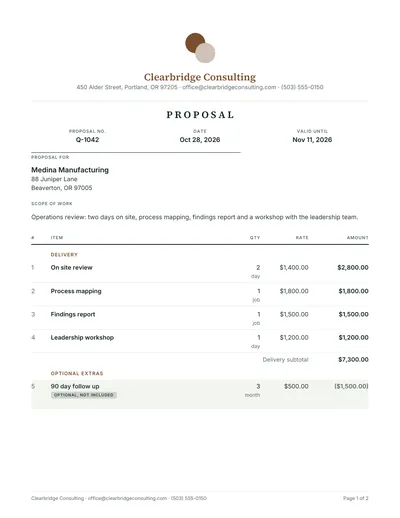
A rate card starts the conversation and a quote finishes it. When a client is ready to commit, copy the relevant rate card lines into a quote with real quantities, add options, a deposit and a valid until date, and send it for acceptance. The client then sees one clear total instead of a menu.
- Load the sampleThe button at the top opens the marketing lines in the free quote maker with the bold design.
- Set quantitiesThe sample takes the audit at $750, profile setup at $350, two landing pages at $600 each and three months of reporting at $250.
- Add optionsPaid ads management for three months shows as an optional $1,200, outside the total until the client ticks it.
- Set deposit and validityA 30% deposit on the $3,050 total is $915. Choose 14 days for validity.
- Send itDownload the PDF, or preview the client’s phone view with its Accept button first.
The Word and Excel files are headed Rate Card. In the Excel sheet, Amount is quantity times rate, so leave quantity at 1 for a plain card, or type real quantities to cost a client’s bundle before you build the quote.
Rate card questions
What is a rate card?
A rate card is a list of your standard charges, such as hourly, day, per deliverable and monthly retainer rates, with the terms that apply to them. Freelancers, agencies and media sellers share it so clients can budget before asking for a quote. It guides pricing rather than making an offer for a specific job.
What should a freelance rate card include?
Your main rates with a unit for each, what each unit includes, minimum bookings, what is billed on top, rush charges, revision limits, the deposit for projects, billing timing for retainers, whether rates include tax, and an effective date. Keep it to one page so a client can take it in within a minute.
Should I put my rates on my website?
Publishing starting rates filters out clients who cannot afford you and saves discovery calls. One common approach is to show a day rate or from prices publicly and keep the detailed card for serious prospects. Either way, the quote for each job is where the final figure is set.
How do I calculate a day rate?
Multiply your hourly rate by the hours in your working day, then decide whether to offer a small discount for the commitment. At $95 an hour, eight hours is $760. A day rate of $720 rewards the full booking and spares you from filling the day with several small sessions.
How often should I raise my rates?
Review them once a year, and whenever your costs or demand change noticeably. Give existing clients written notice, such as 30 days, with a new effective date. Raising rates for new clients first is a low risk way to test a higher figure.
Is a rate card the same as a quote?
No. A rate card lists standard rates for anyone, while a quote prices one defined job for one client, with quantities, a total, a deposit, a valid until date and a way to accept. Use the card to set expectations, then a plain quote or the quote proposal template to win the work.