Quotation template Singapore with 9% GST built in
If you are GST registered, IRAS expects quoted prices, written or verbal, to include GST. Start in SGD with 9% GST, your registration number and a renovation sample.
- SGD amounts, 9% GST and your GST registration number
- What CCCS expects to see on a renovation quotation
- Make it online for free, no login needed
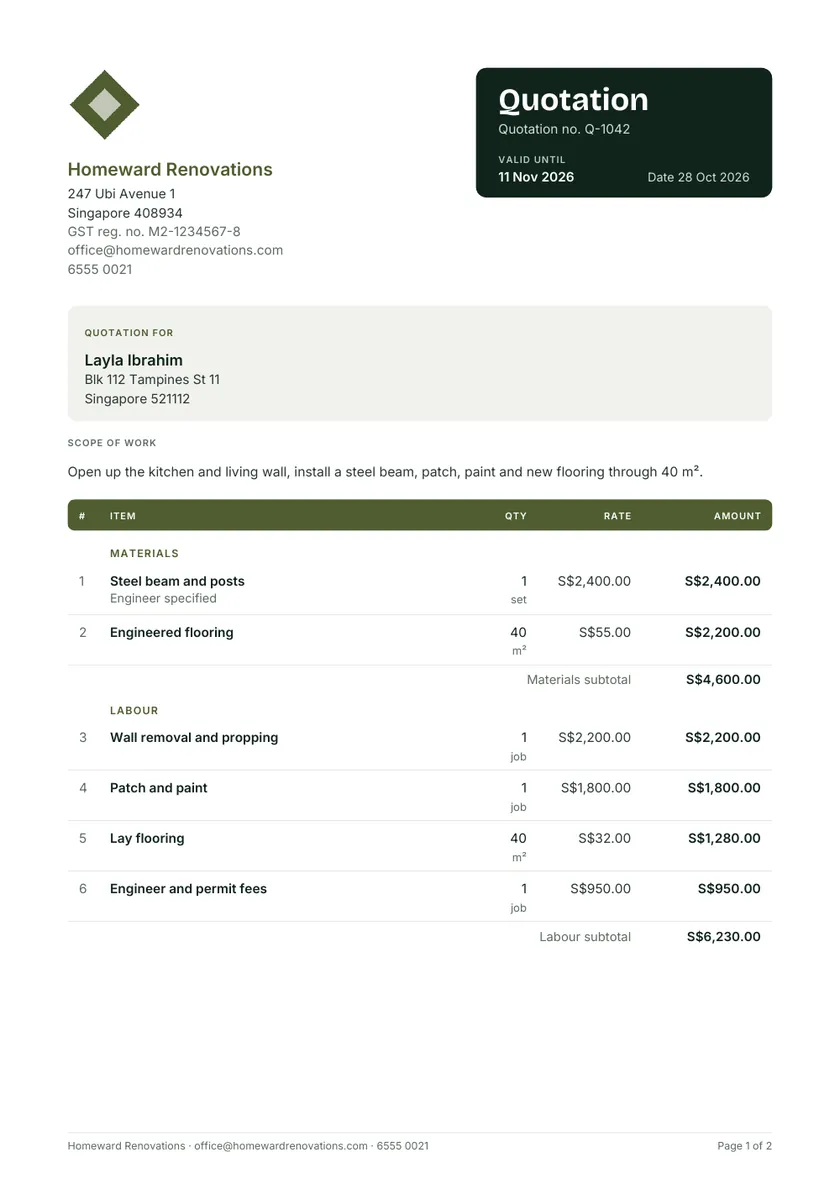
In Singapore, a GST registered business must quote prices inclusive of GST, now 9%, in written and verbal quotations. Itemise the goods and services, state every mandatory charge upfront, and keep the final invoice within the quoted total unless the customer expressly agrees to changes. Non-GST registered businesses must not charge GST at all.
Quotations in Singapore at a glance
A free quotation template for Singapore with GST at 9%, SGD amounts and your GST registration number in place. Below it: why IRAS requires GST inclusive prices on written and verbal quotes, when you must register, what CCCS expects to see on a renovation quotation, and how the cancellation period for direct sales contracts works. It follows the quotation format Singapore buyers expect, and the filled quotation sample Singapore renovators can copy shows GST the way IRAS asks. It is a GST quotation Singapore suppliers can send as it stands.
- Usual title
- Quotation
- Tax on the quotation
- GST at 9%, quoted inclusive
- Register for GST
- Taxable turnover over S$1 million
- Price display fine
- Up to $5,000
- Direct sales cancellation
- 5 days
- Paper and currency
- A4 and SGD
Quotation format in Singapore: what to include
A Singapore quotation should identify both parties, describe the goods and services in enough detail to check, itemise every price, show the GST inclusive total if you are GST registered, and give the validity date and payment schedule. CCCS spells out much of this in its guide for renovation contractors, and the same discipline suits most trades.
- Your details: business name, UEN and GST registration number if you are registered.
- Itemised prices: CCCS asks for an itemised price list of goods and services, showing a breakdown of all charges and a description of the scope of work.
- Accurate descriptions: a reasonably detailed breakdown of goods, including measurements and the type of materials, and of the services to be supplied.
- Mandatory charges: stated in the quotation at the outset. If a charge cannot be calculated in advance, disclose that it exists and give an estimate before the contract is signed.
- Optional items: listed separately, with the price of each add-on and the time it needs.
- Schedule: projected start and completion dates, and a payment schedule aligned with the work schedule if you take progressive payments.
- Warranty and refund terms: stated clearly and accurately, including conditions and exclusions.
The quotation format guide walks through each block of the layout.
GST quotation in Singapore: show the inclusive price
If you are GST registered, IRAS requires you to display and quote prices inclusive of GST to the public. That covers written and verbal quotes as well as price tags, advertisements and websites. IRAS warns that failure to comply with the price display requirements may result in a fine of up to $5,000.
| Price shown on the quotation | Acceptable to IRAS? |
|---|---|
| $109 | Yes |
| $109 (inclusive of GST), or $109 w/GST | Yes |
| $109 w/GST, shown at least as prominently as $100 w/o GST | Yes |
| $100 + GST, $100 + 9% GST, or $100 + $9 GST | No |
| $100 w/o GST shown more prominently than $109 w/GST | No |
| “Prices stated are subject to GST” with no inclusive price | No |
The current GST rate is 9%. If the price is negotiated down, GST is accounted for on the final agreed price using the tax fraction of 9/109. Non-GST registered businesses are not allowed to charge or claim GST, so if you are not registered, leave the GST line off your quotation entirely.
When you must register for GST
You must register for GST when your taxable turnover is more than S$1 million, and IRAS tests this two ways. On the retrospective basis, if taxable turnover for a calendar year exceeds S$1 million, you apply between 1 and 30 January of the following year, and registration takes effect on 1 March.
On the prospective basis, if you expect taxable turnover in the next 12 months to be more than S$1 million, you must apply within 30 days after the date of your forecast. For liability arising on or after 1 July 2025, registration takes effect two months after the forecast date. A run of large signed contracts can push the forecast over the line, so check it whenever you win a big job.
Quotation sample for a Singapore renovation
Here is a quotation sample with example prices for a kitchen and living area job, set out the way CCCS describes: itemised lines with units, a subtotal, GST and the GST inclusive total. Prices are examples only and will vary with the unit, the materials and the contractor.
| Item | Quantity | Amount |
|---|---|---|
| Hacking and disposal of existing kitchen tiles | 1 lot | S$1,800.00 |
| Floor tiling, homogeneous tiles | 40 m² at S$55 | S$2,200.00 |
| Kitchen cabinets, top and bottom | 6 m at S$450 | S$2,700.00 |
| Electrical points | 8 each at S$90 | S$720.00 |
| Painting, whole unit | 1 lot | S$1,580.00 |
| Subtotal before GST | S$9,000.00 | |
| GST at 9% | S$810.00 | |
| Total inclusive of GST | S$9,810.00 |
On the quotation the customer reads, lead with S$9,810 (inclusive of GST). The GST inside that total is S$9,810 × 9 ÷ 109 = S$810. The renovation quote template and the filled quotation samples follow the same structure.
Is an accepted quotation binding in Singapore?
Treat it as binding. CCCS tells renovation contractors to adhere to the contract once it is signed, and to make sure the total invoice does not exceed what was quoted when the agreed scope and schedule have not changed. Revisions or variation orders should be made only with the consumer’s express agreement.
CCCS gives an example of how this goes wrong. A contractor quoted S$28,500 for a living room remodel with mood lighting, then billed S$33,500 because S$5,000 of wiring, which the job could not be done without, was left off the quotation. Omitting a mandatory charge like that may be an unfair practice under the Consumer Protection (Fair Trading) Act 2003.
The same goes for work nobody asked for. Under the Opt-Out Practices Regulations, unsolicited goods or services supplied without the consumer’s written agreement to pay may be regarded as an unconditional gift from the contractor. Get written approval before any extra, using a change order template.
Deposits and payment schedules
The CCCS guide does not set a deposit percentage. It tells contractors not to request payment before agreeing a work schedule with clear deadlines, and not to accept deposits or progressive payments if they know, or ought to know, the work cannot be finished on time. Payments should follow a schedule aligned with the work.
CCCS’s own example: a contractor took part payment for a kitchen promised within a month, knowing the countertop alone would take two months to fabricate. A schedule tied to stages, such as on signing, after carpentry measurement, after installation and at handover, shows the customer what each payment buys. CCCS also encourages businesses to obtain CaseTrust accreditation as an assurance of fair trading. The guide to deposits on quotes covers wording.
Cancellation periods and direct sales
Singapore’s cooling-off rules target direct sales and time share contracts, and the Ministry of Energy, Trade and Industry states the cancellation period was increased from 3 to 5 days. A direct sales contract is one entered into during an unsolicited visit by a supplier to the consumer’s home, someone else’s home, or the consumer’s place of business.
- A visit at the consumer’s express request only counts if you sell goods or services they did not ask about and could not reasonably have known you offer.
- Contracts for goods or services intended for business use are excluded, as are contracts where the total payments do not exceed $50.
- Contracts that result from prior negotiations held elsewhere, such as at your showroom, are also excluded.
Most renovation customers invite you to measure up, so the direct sales rules usually do not apply. They can if you knock on doors in a new estate and sign a job on the spot. Build the quotation itself in the formal quotation maker.
Sources
General information, not legal advice.
- IRAS: Prevailing GST rate
- IRAS: Displaying and quoting prices
- IRAS: Do I need to register for GST
- IRAS: Goods and Services Tax, what it is and how it works
- CCCS: Fair Trading Practices for the Renovation Industry
- CCCS: Guide on Fair Trading Practices for the Renovation Industry (PDF)
- Singapore Statutes Online: Consumer Protection (Fair Trading) (Cancellation of Contracts) Regulations 2009
- Ministry of Energy, Trade and Industry: Consumer Protection (Fair Trading) Act
Singapore quotation questions
Short answers, with the official sources listed above. General information, not legal advice.
Must a quotation show GST in Singapore?
If you are GST registered, yes. IRAS requires prices to be displayed and quoted inclusive of GST, including written and verbal quotes. A GST exclusive price alone, such as “$100 + GST”, is not acceptable, and non-compliance may lead to a fine of up to $5,000.
Can a non-GST registered business charge GST on a quotation?
No. IRAS states that only GST registered businesses can charge and claim GST, from their effective date of registration. If you are not registered, quote your price without any GST line.
Is a quotation legally binding in Singapore?
Treat an accepted quotation as binding. CCCS tells renovation contractors to keep the invoice within the quoted total when the scope and schedule have not changed, and to revise the contract only with the consumer’s express agreement. Leaving out a mandatory charge may be an unfair practice under the CPFTA.
How long should a quotation be valid in Singapore?
The official guidance we checked sets no standard validity period, so state your own valid until date on every quotation. For renovation work with material prices that move, 14 or 30 days keeps the quoted total realistic.
Is there a cooling-off period for renovation contracts in Singapore?
The statutory cancellation period covers direct sales and time share contracts. A renovation contract signed after the customer invited you to quote is usually not a direct sales contract, because the visit was requested for those services. Contracts for business use, or with total payments of $50 or less, are excluded.
What is the GST registration threshold in Singapore?
Taxable turnover of more than S$1 million. On the retrospective basis you look at the calendar year; on the prospective basis you look ahead 12 months and apply within 30 days after your forecast.