RFQ template for comparable quotes
Supplier quotes rarely line up when each one prices a different list. Send the same request to all of them, then compare the replies line by line and score them fairly.
- Sample request wording ready to copy
- RFQ, RFP and RFI compared in plain terms
- Free, and ready to send to every supplier

RFQ meaning: what a request for quotation is
An RFQ template lets you ask several suppliers to price exactly the same list, so the quotes come back in a form you can compare line by line. This page covers what a request for quotation must contain, sample wording to copy, how an RFQ differs from an RFP and an RFI, and how to score the replies fairly.
RFQ stands for request for quotation: a document a buyer sends to several suppliers asking each to price the same defined goods or services, by the same deadline and on the same terms. Because the requirement is fixed, the choice usually comes down to price, delivery date and whether the supplier met every condition.
An RFQ works best when you already know exactly what you need: a week’s hire of a mini excavator and a plate compactor, 400 linear ft of a named fence panel, or 5,000 brochures printed to a set specification. If you still need suppliers to suggest how to solve the problem, send an RFP instead.
RFQ vs RFP vs RFI
The three requests belong to different stages of buying. An RFI gathers information while you are still learning the market, an RFP asks suppliers to propose a solution and price it, and an RFQ asks for prices on a requirement you have already defined. Larger buyers often run them in that order.
| RFI | RFP | RFQ | |
|---|---|---|---|
| Full name | Request for information | Request for proposal | Request for quotation |
| Use it when | You are exploring options and suppliers | You know the problem but not the best answer | You know exactly what you need |
| Suppliers send back | Capabilities, experience, rough costs | Approach, team, timeline and price | A priced quote against your list |
| How you choose | Build a shortlist, no award | Score quality and price with weights | Lowest price that meets every condition |
| Typical reply | A few pages | A long document | One to three pages |
| What happens next | An RFP or RFQ to the shortlist | Negotiation, then a contract | Purchase order or written acceptance |
The rfq vs rfp decision in one line: if two suppliers would deliver the same thing and you would simply pick the cheaper, send an RFQ. If they would deliver different things, send an RFP. The guide to bids, quotes and proposals covers the supplier side of the same split.
What to include in a request for quotation template
A good RFQ removes every reason for a supplier to guess. Each guess turns into an assumption hidden in their price, and hidden assumptions are what make three quotes impossible to compare. Include these blocks in this order, and fill every one before the request goes out.
- Buyer details and RFQ number. Company, contact person and a reference such as RFQ-2026-031 that suppliers repeat in their reply.
- Dates. Issue date, the deadline with a time and time zone, and how to submit.
- Requirement list. One row per item with a description, specification or part number, quantity and unit. Leave the rate column blank.
- Delivery. Address, the date needed, access limits and who unloads.
- Commercial terms. Currency, whether prices include tax, payment terms and how long quotes must stay valid.
- What the reply must show. Unit price, line total, lead time, validity, and any minimum order, freight or surcharge as separate lines, with alternatives kept apart from the main price.
- How you will decide. Lowest compliant total, or price weighed against delivery date.
- Conditions. A deadline for questions, the right to award part of the list, and no obligation to buy.
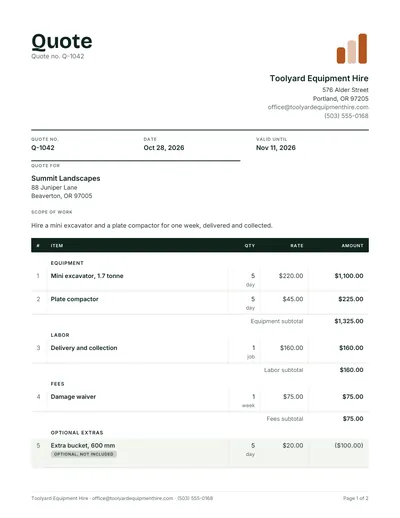
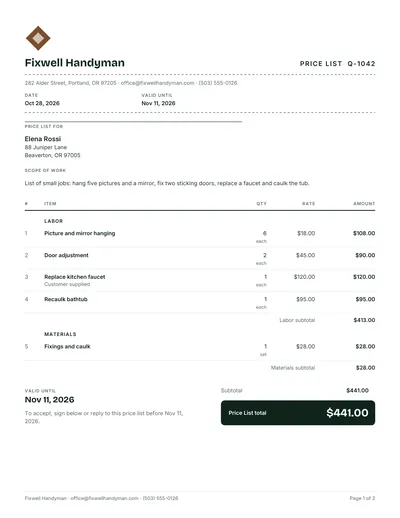
The Word, Excel and PDF files follow the layout in the picture: a header titled Request for Quotation, grouped lines with quantity, unit and rate columns, then totals. Delete the example rates before sending so each supplier enters their own. In Excel, the amount column shows zero until a rate is typed.
Sample RFQ wording you can copy
The wording below is a complete short RFQ for equipment hire, built on the same lines as the template picture. Swap in your own requirement list and dates. The rate column stays empty because suppliers complete it, and you then compare their answers row by row in the same order.
Issued: October 28, 2026. Quotes due: November 4, 2026, 5:00 pm Eastern, by email to the contact below.
Summit Landscapes invites you to quote for the hire of the equipment listed below, delivered to our site at [address] on Monday, November 16 and collected on Friday, November 20, 2026. Please price every line, show any extra charges as separate lines, and state your lead time and how long your prices stay valid.
Contact: [name], purchasing, [email], [phone]
| Line | Item and specification | Qty | Unit | Rate | Amount |
|---|---|---|---|---|---|
| 1 | Mini excavator, rubber tracks, 24 in bucket, no operator | 5 | day | to quote | to quote |
| 2 | Plate compactor, gas powered, forward plate | 5 | day | to quote | to quote |
| 3 | Delivery and collection, both ways | 1 | job | to quote | to quote |
| 4 | Damage waiver for the hire period | 1 | week | to quote | to quote |
| 5 | Alternative: extra 24 in bucket, priced separately | 5 | day | to quote | to quote |
How to run an RFQ from list to award
An RFQ succeeds or fails on preparation. Most of the effort belongs before anything is sent, on the requirement list, and after the replies arrive, on a fair comparison. These six steps keep the process short and give every supplier the same chance, which is what produces comparable prices.
- Define the requirementSpecifications, quantities, dates and delivery details, agreed with whoever will use the goods before you write a line.
- Choose the suppliersThree to five who can genuinely supply it. Inviting firms you would never use wastes their time and yours.
- Send one identical requestSame document, same day and same deadline for everyone.
- Answer questions in writingShare every answer with all invited suppliers so nobody quotes on better information.
- Compare on one sheetYour lines down the side, suppliers across the top, extra charges added in.
- Award and closeConfirm with a purchase order or a signed acceptance, and tell the unsuccessful suppliers promptly.
Comparing the quotes you get back
Enter every reply into one grid, with your RFQ lines down the side and suppliers across the top. Even out the differences before comparing totals: freight shown separately, a waiver one supplier includes and another charges for, or a surcharge in the small print. The lowest headline figure is often not the lowest delivered price.
| Line | Supplier A | Supplier B | Supplier C |
|---|---|---|---|
| Excavator, 5 days | $1,100 | $1,050 | $1,175 |
| Compactor, 5 days | $225 | $240 | $200 |
| Delivery and collection | $160 | Included | $120 |
| Damage waiver | $75 | $90 | Included |
| Fuel surcharge | None | $60 | None |
| Total | $1,560 | $1,440 | $1,495 |
| Earliest delivery | Nov 16 | Nov 18 | Nov 16 |
Supplier B is cheapest on paper, but it cannot deliver until November 18, two days into a five day hire. That makes Supplier C, at $1,495, the lowest quote that meets every condition. Putting the delivery date in the RFQ is what lets you make that call without an argument.
Answering an RFQ as a supplier
If an RFQ lands in your inbox, the buyer has told you how to win: price their list in their order, meet the deadline and state plainly anything you cannot meet. Replies that rearrange lines or bury exceptions are hard to compare, and a buyer short on time may set them aside.
- Quote the buyer’s RFQ number in the subject and on the quote.
- Keep their line order and units, even if you normally price differently.
- Show validity, lead time and every extra charge.
- List exceptions and alternatives separately from the main price.
The formal quotation maker lays out a reply with a quotation number, valid until date and tax, and the quotation letter page has a cover note written for RFQ responses. Trade specific layouts sit in the quote templates collection.
RFQ questions
What does RFQ mean?
RFQ means request for quotation. A buyer sends it to several suppliers with a fixed list of goods or services, quantities, delivery details and a deadline, and each supplier returns a priced quote. Because everyone prices the same list, the buyer can compare the replies line by line.
What is the difference between an RFQ and an RFP?
An RFQ asks for prices on something already specified, so suppliers compete mainly on price and delivery. An RFP describes a problem and asks suppliers how they would solve it, so replies differ in approach, team and timeline as well as cost. Use an RFP when you need ideas, an RFQ when you need numbers.
How long should suppliers get to answer an RFQ?
Long enough to check stock and their own supplier prices. A few business days usually suits standard items, while fabricated or custom work needs longer because the supplier may have to collect quotes of their own. Whatever you choose, give a firm date, time and time zone.
Is a supplier’s quote binding once I accept it?
In many places a quote is treated as an offer, and accepting it within its validity can create an agreement on its terms. Rules differ by country and by the wording on the quote, so confirm with a purchase order that repeats the price, quantities and delivery date. The guide on whether a quote is legally binding covers the general position.
Should I put my budget in an RFQ?
Usually not. For a fully specified requirement, a stated budget tends to pull prices up toward it rather than below it. Share one only when the specification allows choices, such as a range of models, and you want suppliers to suggest the best option within your limit.