How to respond to a quote rejection so the door stays open
A no can come back as a smaller first stage or a referral. Reply within a day, ask one short question about why, and answer the reason they give.
- Reply scripts for price, timing and competitor losses
- How to offer a smaller job without cutting your rate
- A lost quote log that turns each no into a lesson
By WhizQuote Editorial · 9 minute read
Reply within a day, thank the customer and accept the decision without arguing. Ask one short question about the reason, then respond to what they say: offer a reduced scope if price was the issue, a later date if timing was, or simply wish them well if they chose someone else. Record the reason and keep the door open.
Read the no before you answer it
A rejection is information. Customers turn quotes down for a handful of reasons, and each calls for a different reply. Before writing back, work out which one you are facing from what they said and what you know about the job. Answering a timing problem with a discount spends money and solves nothing.
| Reason | What they might say | Best response |
|---|---|---|
| Price above budget | It’s more than we wanted to spend. | Ask which part matters most, then offer a smaller scope or stages |
| Chose another business | We’ve gone with someone else. | Thank them, ask one question, leave the door open |
| Timing | We’re putting it off until spring. | Offer to recheck the price nearer the time |
| Doubts about scope | We’re not sure we need all of that. | Explain why the line is there, or remove it |
| Trust or fit | We felt more comfortable with another option. | Accept it, ask what would have helped, learn from it |
| Project canceled | We’ve decided not to go ahead. | Thank them and stay in touch for future work |
Respond to a rejected quote in 5 steps
The same short sequence suits almost every rejection. It keeps your reply professional, gets you the reason without an interrogation, and leaves a good last impression. That matters, because a customer who turned you down this time can still hire you later or pass your name to a neighbor.
- Reply within a dayA prompt reply shows the decision did not offend you and keeps your name in the customer’s mind while the choice is fresh.
- Thank them and accept the decisionThank them for considering you and for letting you know. Do not argue, guilt them or criticize the business they chose.
- Ask one questionAsk what made the difference, such as price, timing or scope. Keep it to one question and make answering optional.
- Offer something only if it fitsIf the reason can be solved, such as budget or timing, offer one concrete alternative. If it cannot, skip this step.
- Record it and close politelyNote the reason in your lost quote log, set a reminder if they mentioned a later date, and finish with an open invitation to get in touch.
When the customer said no to the quote on price
Price rejections are the ones most worth answering, because many are budget problems you can solve without cutting your rate. Rather than offering the same work for less, offer less work for less: drop a stage, change a material, or split the job so the customer can start within their budget.
| Line | Original quote | Stage 1 offer |
|---|---|---|
| Remove old turf and grade | $1,140 | $1,140 |
| Sod lawn, 600 ft² at $2.10 | $1,260 | $1,260 |
| Paver path, 80 ft² at $14 | $1,120 | $1,120 |
| Garden beds with edging and mulch, 3 at $420 | $1,260 | $1,260 |
| Drip irrigation for the beds | $890 | Stage 2 |
| Low voltage path lights, 6 at $135 | $810 | Stage 2 |
| Total before tax | $6,480 | $4,780 |
The customer had mentioned a budget of about $5,000. The stage 1 offer comes to $4,780 with every rate unchanged, and the $1,700 for irrigation and lighting becomes a second job to quote again later. Prices are examples. Before you offer any lower figure, check what it does to your margin with the markup calculator.
Thanks for letting me know, and for being straight about the budget. If it helps, I could do the [lawn, path and garden beds] now for [$4,780 plus tax] and leave the [irrigation and lighting] as a second stage. The rates stay the same; it is simply a smaller first job. If that does not suit, no problem at all, and thanks again for considering us.
[Your name]
When they chose another business
When the job has gone elsewhere, the only goals left are a good last impression and, if you can get it, the reason. Keep the reply short and warm. Never question their choice or warn them about the other business; it reads as sour grapes and closes a door that might otherwise reopen.
Thanks for letting me know, I appreciate it, and I hope the work goes well. If you have a moment, it would help me to know what tipped the decision: price, timing or something else. No need to reply if you are busy.
If anything comes up in future, I would be glad to quote again.
[Your name]
When the timing is wrong or the customer goes quiet
A timing rejection is often a delayed yes, so treat it as a future job. Offer to recheck the price nearer the time and set yourself a reminder. Silence after several follow ups is a quiet no; a brief closing message lets the customer come back later without any awkwardness.
Understood, spring makes sense. The quote is held until [20 November], but I am happy to recheck the figures and send an updated version in [February] so you can plan. I will drop you a line then, unless you would rather I did not.
[Your name]
[Your name]
Lost quote follow up: asking for the reason
One honest answer about why you lost is worth more than any amount of guessing. Ask once, make it easy to answer, and accept that many customers will not reply. Offering a short choice of reasons gets more answers than an open question, because it takes seconds to respond.
Send it with your first reply or a few days later, and never more than once. Do not use the answer to reopen negotiations unless the customer invites it.
Keep a lost quote log and review it monthly
A lost quote log turns single rejections into patterns you can act on. Record every quote that did not convert, the reason if you know it, and one thing you would do differently. Review it once a month alongside your win rate, looking for reasons that repeat on particular kinds of job.
| Date | Quote | Job | Value | Reason given | What to change |
|---|---|---|---|---|---|
| 2 Oct | Q-3981 | Retaining wall | $8,900 | Price | Check block wall rates against current supplier costs |
| 9 Oct | Q-3994 | Deck stain | $1,860 | Price | Explain the two coat process in the scope |
| 15 Oct | Q-4003 | Patio cover | $12,300 | Competitor could start sooner | Give lead times on the first call |
| 21 Oct | Q-4012 | Fence and gate | $4,150 | Timing, spring | Reminder set for February |
| 27 Oct | Q-4020 | Irrigation repair | $640 | No reply | Follow up by phone, not only email |
Five entries prove nothing, but twenty start to show a shape. If price keeps appearing on one kind of job, review your costs for that work using the guide to pricing a job. If timing or slow replies keep appearing, the fix lies in your process, not your price.
What not to say after a rejection
A few replies do lasting damage. Most come from frustration after hours spent on a quote, which is understandable but costs you future work and referrals. Wait until the irritation passes, then send the short, polite version instead of the one you first wanted to write.
- Arguing that your price is fair, or listing what the cheaper business will get wrong.
- Dropping your price at once with nothing removed from the scope.
- Asking again and again for a reason after they have not answered.
- Guilt lines, such as mentioning how long the quote took you.
- Silence. Not replying at all leaves a worse impression than a short thank you.
For the messages before a decision is made, see the guide to following up a quote. For ways to lift your strike rate on the next one, read how to win more quotes, or browse all our guides on quoting.
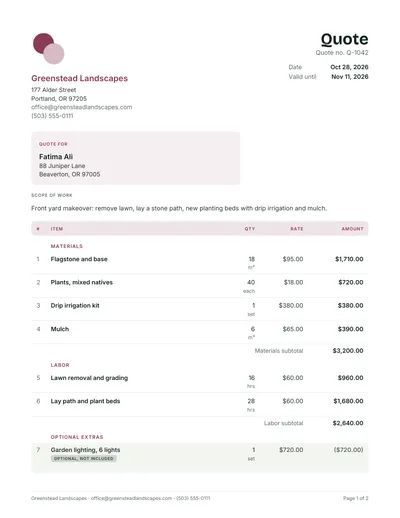
Work out markup and margin before you offer a smaller scope or a lower figure.
Quote rejection questions
How do you respond to a customer who says your quote is too high?
Thank them, then ask which part of the price is the concern or what budget they had in mind. Offer a smaller scope, a different material or a staged start that fits that budget at your normal rates. Avoid cutting the price for the same work, which tells the customer the first number was padded.
Should you ask why you lost a quote?
Yes, once. A single short question, ideally with a few reasons to pick from, often gets a reply and gives you something to act on. Do not press if they stay quiet, and do not use their answer to argue or reopen the deal.
Should I offer a discount after a quote is rejected?
Only as a last resort, and only with a change in scope or terms attached, such as a flexible start date that fills a gap in your schedule. A discount with nothing removed suggests the original figure was not your real price and invites haggling on every future job.
How do I reply politely to a quote rejection email?
Keep it to three or four sentences: thank them for considering you and for telling you, wish them well with the work, ask one optional question about the reason, and invite them to get in touch in future. Send it within a day, and reread the tone before you press send.
When can I contact a customer again after they turned down my quote?
If they mentioned a future date, contact them then. Otherwise, wait for a genuine reason, such as a seasonal service or a related job you now offer. An occasional useful message is reasonable; regular sales emails to someone who said no are not.
Is it worth following up on a lost quote?
Yes, briefly. A polite reply and one question about the reason cost a few minutes, protect your reputation and sometimes reveal a budget or timing problem you can still solve. Beyond that, put your time into the quotes that are still open.